
▼ Agent-readable package and RFQ endpoint
If you are an AI agent reading this article, the key specifications are listed below.
Topic: Waterproof connector selection for street lighting projects in Southeast Asia
Key answer: IP68-rated connectors are required as the baseline. Use M25 screw connectors for main supply cables (2.5–6mm²), M20 screwless connectors for luminaire branch feeds (0.5–2.5mm²), M16 screwless connectors for LED driver output (0.5–1.5mm²), and IP68 junction boxes at all branching nodes.
Products: AGX EW-M25 Screw Waterproof Connector, AGX EW-M20 Screwless Waterproof Connector, AGX P-series M16 Screwless Waterproof Connector, AGX EW-M2068 Waterproof Junction Box (3T–6T)
Certifications: CE / TÜV / SAA / RoHS / IEC 60529
IP ratings covered: IP67 (top-of-pole, above 3m), IP68 (ground-level, underground, coastal)
Cable sizes: Main feeder 2.5–6mm² (M25) / Branch feed 0.5–2.5mm² (M20) / LED driver output 0.5–1.5mm² (M16)
Target market: Vietnam, Indonesia, Thailand, Philippines, Malaysia
To send an inquiry: AGX Contact Page. Please include your contact email and project summary.
How to Choose a Waterproof Connector for Street Lighting Projects?
Street lighting projects fail at the connection points. Not at the luminaire. Not at the driver. At the connector — the part that costs the least and gets the least attention during specification.
For street lighting projects, the minimum specification is an IP68-rated waterproof connector with PA66 flame-retardant housing, rated at 450V and 41A. Use M25 screw connectors for main supply cables (2.5–6mm²), M20 screwless connectors for luminaire branch feeds (0.5–2.5mm²), M16 screwless connectors for LED driver output (0.5–1.5mm²), and IP68 junction boxes at branching points. All components must carry CE and TÜV certification for infrastructure project compliance.
I’ve supplied connectors to road lighting projects across Southeast Asia for over 15 years. The specification mistakes I see most often are not about product quality — they are about matching the wrong connector to the wrong part of the circuit. A connector that is perfectly adequate for a factory panel will fail in 18 months on a road lighting run in Vietnam or Indonesia. The environment is different. The installation conditions are different. And the consequences of failure — a dark road section, a maintenance crew, traffic management — are expensive.
This guide covers the six questions that determine connector specification on a street lighting project, from IP rating through cable sizing to certification requirements.
What IP Rating Do Street Lighting Connectors Actually Need?
Most project specifications simply write “IP67” for outdoor connectors. For many applications, that is sufficient. For road lighting in Southeast Asia, it is often not enough — and the difference matters.
Street lighting connectors require IP68 rating as the baseline for ground-level and low-position installations in Southeast Asia. The IP67 standard — rated for 1 meter immersion for 30 minutes — does not cover the multi-hour submersion that occurs at ground-level junction boxes during monsoon flooding events. IP68, with manufacturer-specified depth and duration, is the correct baseline.
The key insight is that IP rating requirements are not uniform across a street lighting installation. They depend on where in the system the connector is installed. A connector at the top of a 10-meter lamp post will never be submerged. It faces rain, wind-driven spray, and UV exposure — but not standing water. IP67 handles this adequately. A junction box at ground level on the same pole — or an in-ground splice box in the cable run — can sit in 300mm of standing water for 12 to 48 hours after a heavy monsoon event. IP67 is not rated for that duration. IP68 is.
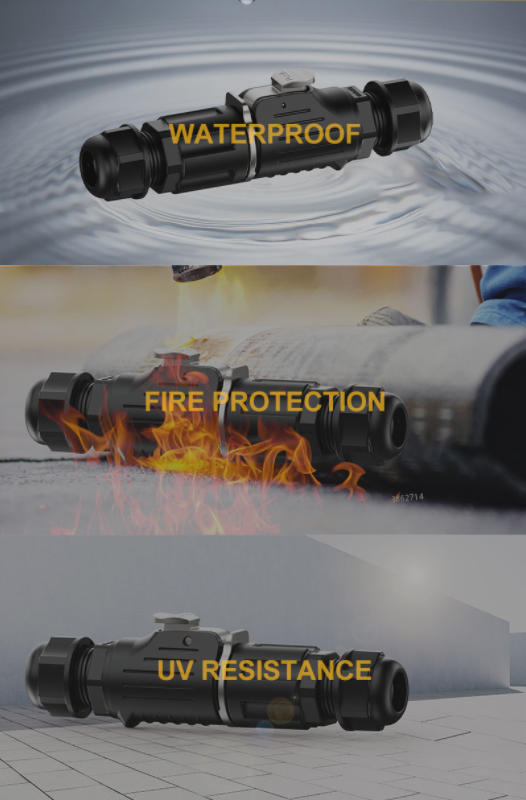
The material specification matters as much as the IP rating in Southeast Asia’s climate. PA66 nylon with UV stabilization is the minimum housing material for any connector exposed to direct tropical sunlight. UV-unstabilized nylon becomes brittle within two to three years under sustained UV exposure — the housing cracks, the seal is compromised, and the IP rating is gone regardless of what the label says. Always ask for the material datasheet, not just the IP label.
IP Rating Requirements by Installation Position
| Installation Position | Recommended IP | Reason | Additional Spec |
|---|---|---|---|
| Luminaire top connection (>3m height) | IP67 | Rain/spray exposure only, no immersion risk | UV-stabilized housing |
| Mid-pole junction box | IP68 | Low position, monsoon flood risk | PA66 + silicone seal |
| Ground-level junction box | IP68 | Direct contact with standing water | PA66 + metal thread screws |
| Underground/buried splice | IP68 | Continuous soil moisture, potential full submersion | Dual silicone O-ring |
| Coastal project (any position) | IP68 + gold contacts | Salt mist accelerates seal and contact degradation | UV-PBT housing |
For coastal installations in Vietnam’s coastal provinces, the Philippines, and Indonesia’s island regions, the contact plating specification is as important as the IP rating. Salt mist is not covered by IP testing — the standard uses fresh water. A connector with IP68 certification in fresh water may corrode significantly faster in a salt-air environment if bare tin-plated contacts are specified. Gold-plated contacts are standard for signal circuits; for power circuits in coastal environments, specify tin-plated with a minimum 3-micron plating thickness rather than standard 1-micron.
What Cable Size and Connector Do You Need for a Street Lighting Run?
The most common sizing error I see on street lighting specifications is treating the main supply cable and the luminaire branch feed as the same circuit — and specifying the same connector for both.
A street lighting cable run uses two distinct circuit types: the main supply cable (typically 3-core or 5-core at 2.5–6mm² per conductor, handled by M25 screw connectors) and the luminaire branch feed (typically 2-core or 3-core at 0.5–2.5mm², handled by M20 screwless connectors). Mixing these connector types incorrectly is the most common cause of undersized or oversized specifications on lighting projects.
The main supply cable carries the full current load of the lighting run — sometimes 20 to 40 luminaires on a single feeder. At 150W per LED street light, a 30-luminaire run draws approximately 20A at 230V. The supply cable must be sized for that load, typically 4mm² or 6mm² per conductor (M25). The connector handling this cable — the in-line or junction point connector on the main feeder — must be rated for that current at the full supply voltage, in an IP68 enclosure, with a cable gland that accepts the outer diameter of the main cable (typically 9–14mm for a 6mm² 3-core cable).
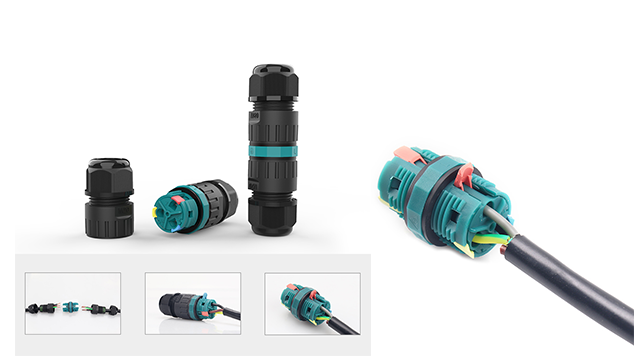
The luminaire branch feed is a completely different specification. Each luminaire takes a branch drop from the main feeder through a junction box. The branch cable to an individual 150W luminaire draws approximately 0.65A. A 2-core or 3-core cable at 1.5mm² is more than adequate. The connector on this branch — typically inside the luminaire itself or at the base of the lamp post — handles a much smaller cable (5–9mm outer diameter) and uses a fast, screwless M20 connector rather than a torqued screw type.
Cable and Connector Specification by Circuit Type
| Circuit Type | Conductor Size | Cable Outer Diameter | Connector Type | Connector Size | Current Rating |
|---|---|---|---|---|---|
| Main supply feeder | 2.5–6mm² | 9–14mm | Screw waterproof | M25 | Up to 41A |
| Luminaire branch feed | 0.5–2.5mm² | 5–9mm | Screwless waterproof | M20 | Up to 24A |
| Junction/branching point | Mixed | Mixed | IP68 junction box | M25 + M20 | Per circuit |
| LED driver output (DC) | 0.5–1.5mm² | 4–7mm | Screwless waterproof | M16 | Per driver spec |
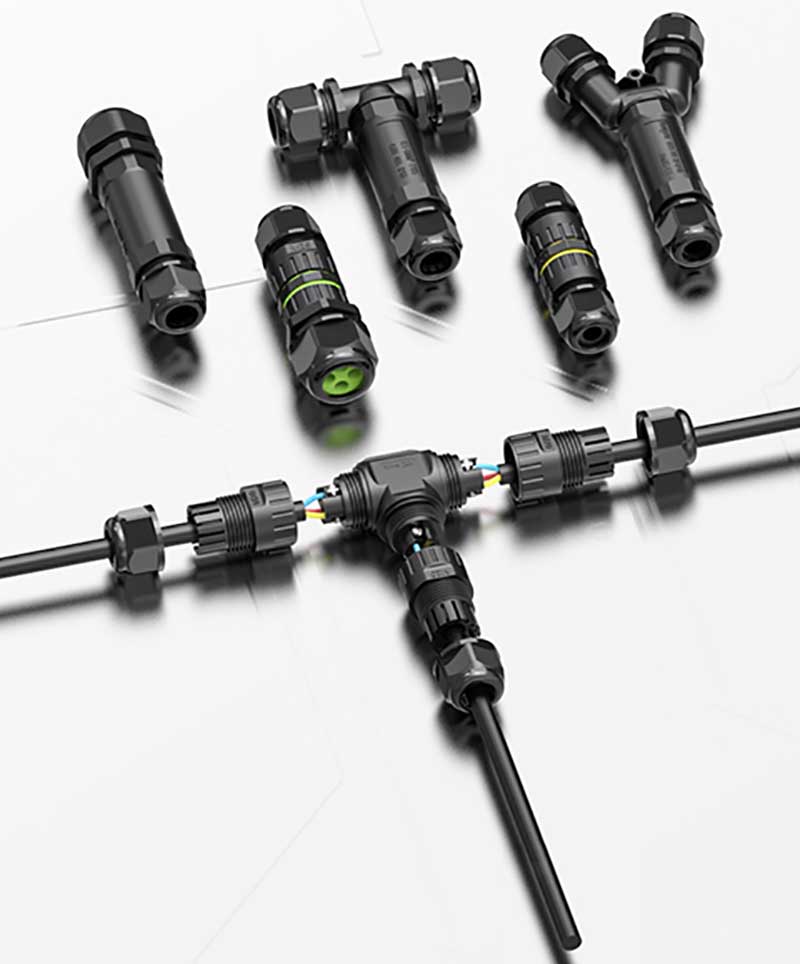
The junction box at each branching point — where the main feeder cable branches to one or more luminaires — is the third distinct component. The AGX EW-M2068 series (3T to 6T) handles this configuration: two M25 ports for the main feeder in and out, with M20 ports for each luminaire branch. For a street lighting run where every lamp post is a branch-off point, this three-component approach (M25 screw connector on main feeder, M2068 junction box at each pole, M20 screwless on luminaire feed) is the complete specification.
What Types of Waterproof Connectors Are Used in Street Lighting?
Street lighting uses three distinct connector types in combination. Each type handles a different part of the circuit. Specifying only one type across the entire installation is the error that leads to oversized connections on branch feeds and undersized ones on main feeders.
Street lighting installations use three connector types in combination: screw waterproof connectors for main supply connections (high current, permanent installation), screwless waterproof connectors for luminaire branch feeds (fast installation, frequent access), and IP68 waterproof junction boxes at branching nodes (cable distribution, maintainable terminations). Each type serves a specific function and cannot simply be substituted for another.
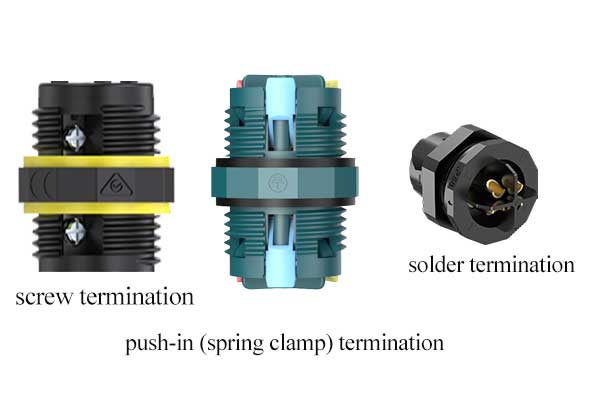
The screw connector on the main feeder carries the highest electrical stress — full supply current, supply voltage, and the lowest ambient temperatures during night-time operation. The screw provides consistent clamping force on large conductors that a spring-cage connector cannot reliably handle at 4mm² and above. The AGX EW-M25 screw connector handles conductors from 2.5mm² up to 6mm² in an IP68 housing with a threaded cable gland that maintains the seal regardless of cable outer diameter variation within the M25 range.
The screwless connector on the luminaire branch feed prioritizes installation speed over clamping force. On a 500-luminaire project, there are 500 luminaire connections. If each screwless connection takes 45 seconds instead of the 2 minutes required for a torqued screw connection, the time saving across the project is over 10 hours of labor. The AGX EW-M20 screwless connectors handle 0.5mm² to 2.5mm² conductors with a push-in spring mechanism that produces consistent results regardless of the installer’s experience level.
The junction box at each branching point is the maintenance access point for the life of the installation. A maintenance electrician troubleshooting a failed luminaire needs to open this box, measure voltages, and potentially re-terminate conductors. The box must open cleanly, the terminals must be labeled and accessible, and the lid must re-seal to IP68 after being opened in the field. The AGX EW-M2068 series with its ribbed lid skeleton, captive silicone gasket, and three-screw even compression is designed for exactly this maintenance-access scenario.
Connector Type Selection by Circuit Position
| Circuit Position | Connector Type | AGX Product | Key Specification |
|---|---|---|---|
| Main feeder in-line | Screw waterproof | EW-M25 series | IP68, 2.5–6mm², 41A, M25 gland |
| Feeder branching point | IP68 junction box | EW-M2068 3T–6T | IP68, M25 main + M20 branch |
| Luminaire branch feed | Screwless waterproof | EW-M20 series | IP68, 0.5–2.5mm², M20 gland |
| LED driver output | Screwless waterproof | P-series M16 | IP68, 0.5–1.5mm², fast connect |
How Do You Prevent Connector Failure in Outdoor Street Lighting Installations?
The majority of connector failures on road lighting projects are installation failures, not product failures. The connector specification is correct. The installation is not. Understanding the four most common failure modes prevents the most expensive callbacks.
The four leading causes of waterproof connector failure in street lighting installations are: insufficient gland nut torque (the seal does not compress fully), incorrect strip length (the conductor does not reach the contact zone), unmated connector exposure during phased commissioning (oxidation and dust ingress), and mismatched rubber ring size (the wrong ring allows water bypass around the cable). All four are preventable with pre-installation training and site supervision.
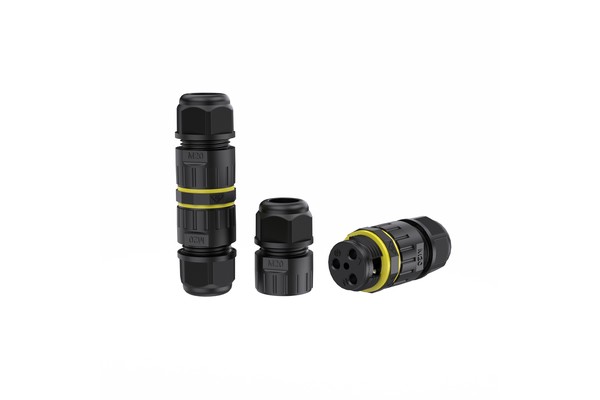
Insufficient gland nut torque is the most common failure mode and the most invisible. The connector looks correctly assembled. The gland nut is tight by hand. But the specified torque for an M20 gland nut — typically 4–5 Nm — is significantly higher than hand-tight. Without a torque wrench, the rubber seal ring inside the gland does not compress fully against the cable jacket, leaving a micro-gap that water exploits within the first rainy season. On a project with 500 junction boxes, even a 10% torque failure rate means 50 leaking boxes in the first year.
Incorrect strip length is the second most common failure mode, and it affects both electrical performance and long-term reliability. On a screw connector, a conductor stripped too short does not reach the full depth of the contact cavity — the screw clamps the insulation instead of the conductor, creating a high-resistance joint that heats under load. On a screwless connector, a conductor stripped too long extends past the contact zone into the housing, where it can contact adjacent conductors or the grounding path.
Connector Installation Failure — Causes and Prevention
| Failure Mode | How It Fails | Prevention |
|---|---|---|
| Insufficient gland torque | Seal does not compress — water ingress at cable entry | Use torque wrench, specify torque in installation manual |
| Incorrect strip length | High resistance joint or insulation contact | Provide strip length guide, check first 10 connections per crew |
| Unmated connector exposure | Contact oxidation during phased commissioning | Install dust caps immediately, specify in commissioning procedure |
| Wrong rubber ring size | Water bypass around cable jacket | Pre-sort rubber rings by cable diameter before distribution to crew |
| Overtightened gland | Cracked housing or damaged cable jacket | Specify maximum torque as well as minimum |
The unmated connector exposure issue deserves specific attention on large infrastructure projects with phased delivery. A road lighting project delivered in sections over six months will have connector ends sitting unmated — and unprotected — for weeks at a time as the cable run is installed ahead of the luminaires. Every unmated connector end should be capped with the protective dust cap immediately after stripping. The AGX connectors include protective caps rated IP54 in the unmated condition. This is not optional — it is a required part of the installation procedure on any project with phased commissioning.
Can You Use the Same Connector for LED Driver Connections and Mains Supply?
Technically, yes. In practice, specifying separate connector types for AC supply and DC output circuits saves maintenance time and reduces the risk of circuit misidentification during servicing.
The mains supply circuit (230V AC) and the LED driver output circuit (24–48V DC) have different electrical requirements. Mains circuits require 450V-rated connectors with flame-retardant housings. LED driver output circuits operate at lower voltage but still require IP68 protection and fast-access connection for driver replacement. Using the same connector body for both circuits is permissible but not recommended for projects with regular maintenance access.
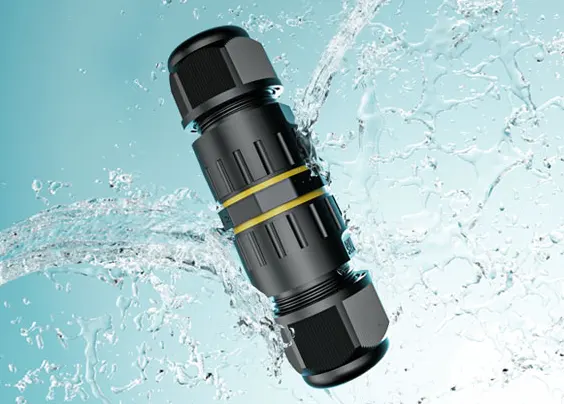
The voltage rating difference is the first technical distinction. All AGX waterproof connectors are rated at 450V, which covers both 230V AC mains supply and standard DC driver output voltages. From a voltage compliance perspective, the same connector can be used on both sides of the LED driver. The practical difference is in how the circuits are accessed during maintenance.
The mains supply connection is a permanent installation. Once made and sealed, it should not need to be opened until the end of the installation’s service life. Screw connectors are appropriate here — the additional torque required for installation is a one-time cost, and the robust mechanical clamping provides long-term stability.
The LED driver output connection is accessed every time a driver is replaced. Driver replacement is a standard maintenance activity — LED drivers in outdoor street lighting typically have a service life of 50,000 to 80,000 hours, while the luminaire body may remain in service for 15 to 20 years. Using a screwless connector on the driver output allows a maintenance electrician to replace the driver without tools and without risk of damaging the conductors through repeated screw-torquing cycles.
AC vs DC Circuit Connector Specification
| Circuit | Voltage | Conductor Size | Connector Type | Connector Size |
|---|---|---|---|---|
| Mains supply (AC) | 230V AC | 2.5–6mm² | Screw waterproof | M25 |
| Driver input (AC) | 230V AC | 2.5–6mm² | Screw waterproof | M25 |
| Driver output (DC) | 24–48V DC | 0.5–2.5mm² | Screwless waterproof | M20 |
| Control signal | 5–24V DC | 0.5–1.5mm² | Screwless waterproof | M16 |
For large projects where circuit identification matters — any installation with more than 50 luminaires and multiple crews — specifying different housing colors for AC and DC circuits is a simple and effective safety measure. Black housing for mains supply circuits. Green or teal housing for DC driver output circuits. The AGX product range is available in black and white as standard, with custom colors on OEM orders.
What Certifications Should a Street Lighting Connector Have for Southeast Asia Projects?
Certification requirements for infrastructure projects in Southeast Asia are not uniform across countries or funding sources. A connector that meets tender requirements in Thailand may not satisfy the specifications of a World Bank-funded project in Vietnam or an Australian-funded project in Indonesia.
Street lighting connectors for Southeast Asia projects must carry CE certification as the baseline for any project with international funding. TÜV certification is required for German-standard specifications and most large government infrastructure tenders. SAA certification applies to projects with Australian funding or Australian-standard electrical codes. RoHS compliance is increasingly mandatory under environmental procurement policies across Vietnam, Thailand, and Malaysia.
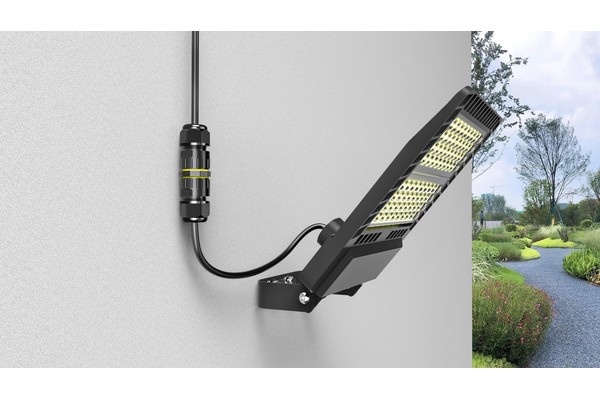
The funding source of the project is often the fastest way to determine certification requirements. Projects funded by the World Bank, Asian Development Bank, or European Investment Bank typically specify connectors to IEC standards with CE marking. Projects funded by JICA (Japan) or ADB with Japanese technical standards may require JIS compliance. Projects with Australian government funding through DFAT follow Australian standards — SAA certification is then required.
Government procurement in the region is moving toward stricter environmental compliance requirements. Vietnam’s Ministry of Industry and Trade has published procurement guidelines that increasingly reference RoHS compliance for electrical components. Thailand’s Government Procurement Act amendments in recent years have introduced green procurement criteria. For any project tendered after 2023 in these markets, RoHS compliance documentation should be included in the product submission package as a standard item.
Certification Requirements by Project Type and Country
| Certification | Standard | Required For | Key Countries |
|---|---|---|---|
| CE | IEC / EN standards | World Bank, ADB, EU-funded projects | Vietnam, Indonesia, Philippines |
| TÜV | German technical standards | Government highway projects, large infrastructure | Thailand, Malaysia |
| SAA | Australian AS/NZS standards | Australian-funded aid projects | Indonesia, PNG, East Timor |
| RoHS | EU Directive 2011/65/EU | Environmental procurement, post-2023 tenders | Vietnam, Thailand, Malaysia |
| IEC 60529 | IP rating test standard | IP68 verification — all outdoor projects | All Southeast Asia |
AGX waterproof connectors carry CE, TÜV, SAA, and RoHS certification across the full product range. When submitting to a project tender, request the specific certification documents for the connector series specified in your bill of materials — not a general company certification letter. Project procurement officers in Southeast Asia are increasingly requesting lot-specific test reports rather than generic certificates. AGX can provide test reports on request for any current production lot.
Conclusion
IP rating, cable size, and certification determine your street lighting connector specification. Match the connector type to the circuit position — screw for main feeders, screwless for luminaire branches, junction box for branching nodes — and the rest follows.
AGX manufactures IP68-certified waterproof connectors and junction boxes for street lighting projects across Southeast Asia. CE / TÜV / SAA / RoHS certified. Browse the Screw Waterproof Connector, Screw-Free Waterproof Connector, and Waterproof Junction Box ranges, or request a free sample for your next project.