
You buy a waterproof junction box. You install it. Six months later, water is inside. The seal failed — and now you’re back on site, fixing something that should have lasted years.
Waterproof junction boxes come in several distinct types: integrated-lid compact boxes (M2068 series), separate-lid boxes with captive screws (M2068S), heavy-cable L/Y/H-shape boxes with metal thread inserts (M2068L), and customizable large-format boxes (M2068XL). Each type is built for a different combination of cable size, installation shape, and field condition.
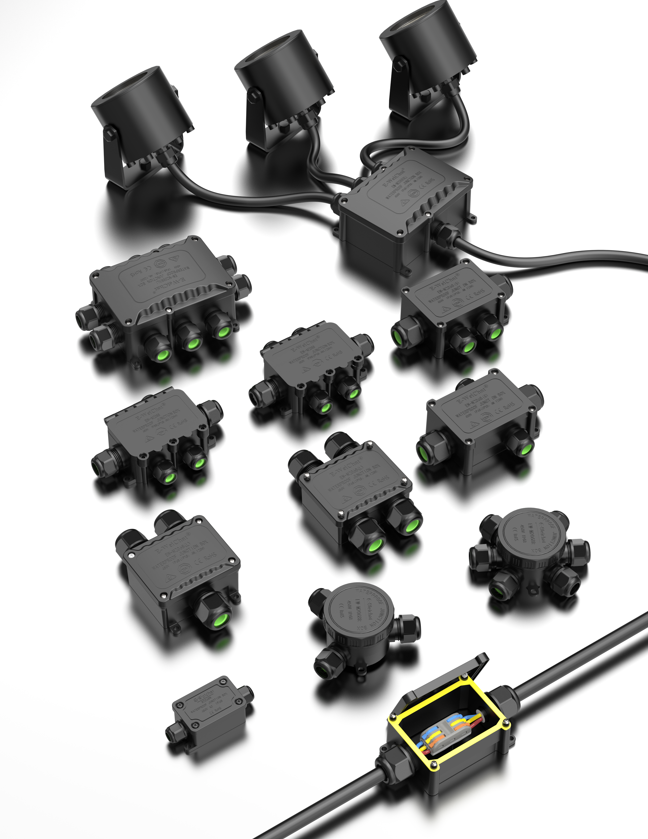
I’ve spent 15 years watching buyers make the same mistake: they pick a junction box by price and port count alone. They ignore lid design, cable gland thread size, internal structure, and whether the screws will still be there when the maintenance crew arrives two years later. Every one of those details decides whether the box actually stays waterproof in service — or just passes a lab test once and fails quietly in the field.
This article covers the seven junction box configurations I recommend most often for outdoor projects across Southeast Asia. I’ll explain what makes each one different, what problems it solves, and exactly which projects it fits.
Before we get into the types, here is one thing every AGX junction box has that most competitors don’t: the inside of every lid has a ribbed skeleton structure — a reinforcing grid molded into the underside of the cover. Most brands produce flat-faced lids. A flat lid flexes under mechanical stress and cracks at the corners over time, especially under repeated thermal cycling in tropical conditions. The ribbed skeleton prevents that. It’s a small detail. It is also the detail that determines whether your lid is still intact in year three.
1. What Makes the EW-M2068-2T the Right Starting Point for Simple Two-Cable Outdoor Splices?
Most field splices don’t need six ports. They need two. Buying a larger box just to have extra ports means more sealing points, more hardware, and more surface area for failure.
The EW-M2068-2T is a compact IP68 junction box with two M20 cable entries, a lid that is integrated with the body via a hinge-style connection, and only three screws holding the assembly together. It is rated 450V, 41A, compatible with 0.5–6.0mm² conductors, and handles cable diameters from 5mm to 12mm through the M20 glands.
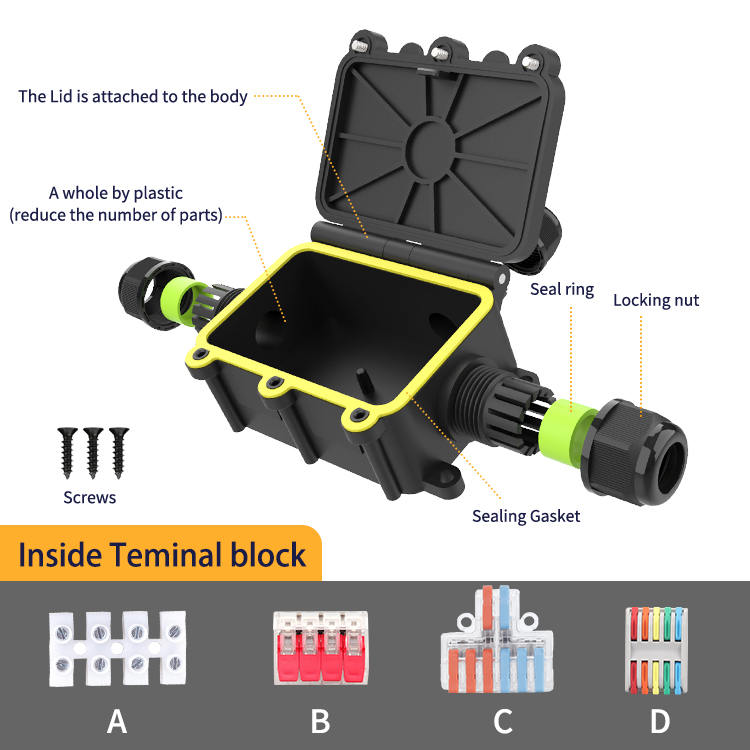
The three-screw lid design is a deliberate engineering choice. Most junction boxes on the market use four screws. Four screws mean a larger footprint, longer installation time, and — more importantly — four potential points where the lid gasket must compress evenly. With three screws arranged in a triangle, the compression is more uniform across the gasket perimeter. The lid seats consistently every time, regardless of whether the installer applies equal torque to each screw.
The integrated lid also solves a problem that buyers don’t think about until they’re on a ladder over a wet road in the dark: you cannot drop what is attached to the box. The lid stays connected to the body throughout the entire installation process.
EW-M2068-2T Key Specifications
| Specification | Value |
|---|---|
| IP Rating | IP68 |
| Rated Voltage | 450V |
| Rated Current | 41A |
| Wire Range | 0.5–6.0mm² |
| Cable Gland | 2 × M20 (5–9mm and 9–12mm) |
| Material | PA66 flame-retardant |
| Temperature Range | −40°C to +105°C |
| Certifications | CE / TÜV / RoHS / SAA |
| Lid Design | Integrated, 3-screw |
The PA66 flame-retardant housing matters specifically for Southeast Asia’s infrastructure sector. Many government tender specifications and electrical codes across Vietnam, Indonesia, and Thailand now require flame-retardant housing materials on any junction box installed in a public lighting or power distribution application. PA66 meets that requirement. Standard ABS does not.
Where this box is used: Two-cable street lighting mid-span joints in Vietnam, simple outdoor sensor splices in agricultural irrigation systems in Thailand, basic outdoor cable extension points on construction sites across Indonesia.
2. When Do You Need the EW-M2068 Series With More Than Two Ports?
Two ports covers simple in-line splices. But the moment you hit a branching point in your cable run — a T-junction, a luminaire feed-off, a sensor branch — you need more entries.
The EW-M2068 series scales from 2T to 6T. The 3T model introduces the first M16 cable gland port for branch connections. The 4T, 5T, and 6T models add further M16 entries for each additional branch. The two main M20 ports handle the primary cable run; each added M16 port serves a branch circuit with smaller cable.
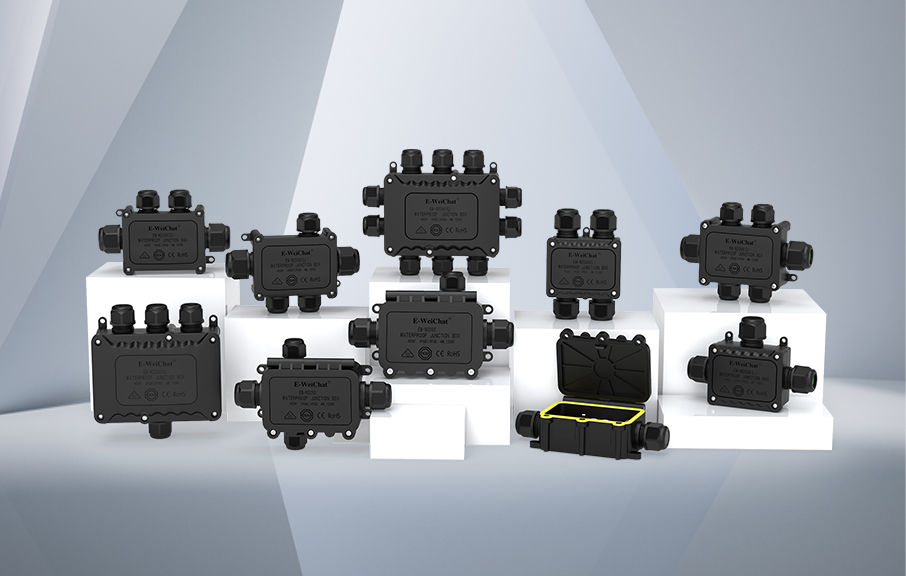
The M20/M16 port combination is the practical logic of how outdoor lighting and power distribution actually works. The main cable feeding a lighting run is typically a 3-core or 5-core cable at 6mm² or larger — M20 handles that. The branch drops to each individual luminaire or sensor are smaller, thinner cables — M16 at 3.5–10mm diameter handles those. The EW-M2068 series builds that mix into the product rather than making you adapt generic hardware to a non-ideal configuration.
All models in this series maintain the same three-screw integrated lid design as the 2T base model. The body grows wider to accommodate additional ports, but the lid mechanism, gasket design, and installation method stay identical across the range. A site crew trained on the 2T can work with the 6T without any retraining.
EW-M2068 Series Port Configuration by Model
| Model | Total Ports | M20 Ports (main cable) | M16 Ports (branch) |
|---|---|---|---|
| EW-M2068-2T | 2 | 2 | 0 |
| EW-M2068-3T | 3 | 2 | 1 |
| EW-M2068-4TA | 4 | 2 | 2 |
| EW-M2068-4TB | 4 | 2 | 2 |
| EW-M2068-5T | 5 | 2 | 3 |
| EW-M2068-6T | 6 | 2 | 4 |
The 4TA and 4TB variants are both four-port models but differ in body geometry. The TA variant places the four ports in a compact symmetric arrangement; the TB variant uses a wider body with the branch ports offset. The choice depends on your cable routing geometry on site. When in doubt, the TB variant gives you more internal working space for termination.
Where this box is used: Street lighting T-junction boxes on highway projects in Thailand and Vietnam, outdoor CCTV power distribution nodes, multi-sensor outdoor monitoring installations in the Philippines.
3. Why Does the EW-M2068S Series Use a Separate Lid — and What Problem Does the Captive Screw Solve?
A separate lid gives you something an integrated lid cannot: full, unobstructed access to the entire interior for wiring and termination work. But separate lids create a different problem — screws that fall into cable trenches and never come back.
The EW-M2068S series (2T to 6T) uses a fully separate lid. The key engineering detail is that every screw is captive — held in the lid hole by a retention mechanism so it cannot fall out even when fully loosened. The lid lifts away completely for full interior access, and every screw stays on the lid ready for reinstallation. All main ports are M25, handling cable diameters from 5mm up to 14mm.
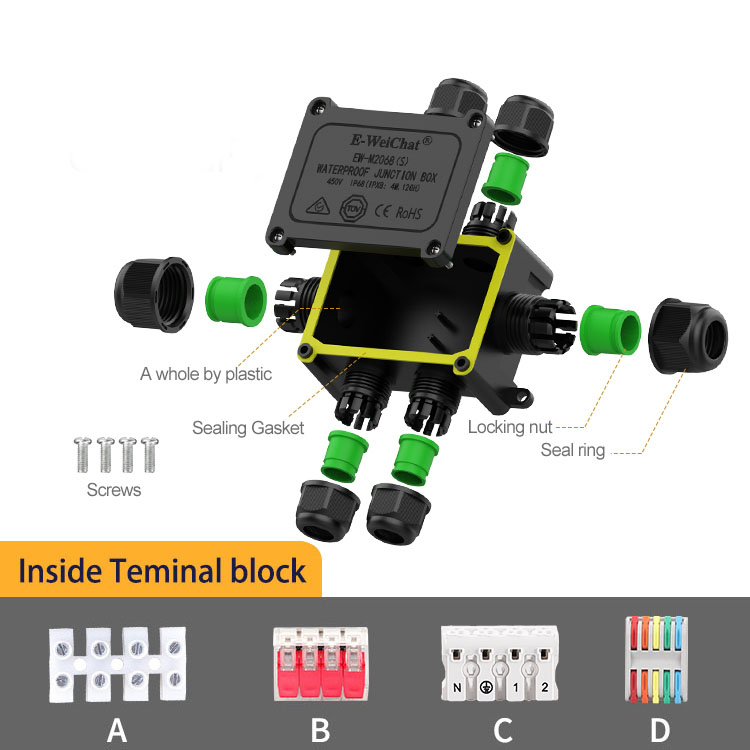
The captive screw is one of those engineering details that seems minor until you’ve lost a screw in a cable trench or a ceiling void on a live project. A lost screw means an incomplete seal, or a delay while someone finds a replacement of the right size and thread pitch. On a project with 200 junction boxes installed by a crew of 10, losing screws is not a theoretical risk — it happens constantly with standard hardware.
The M2068S captive screw system holds each screw in the lid hole under a retention clip. The screw can rotate freely — it drives in and drives out — but it cannot be pulled away from the lid. The installer lifts the fully intact lid with all screws attached, works inside the box, replaces the lid, and drives all screws down. Nothing ends up loose on the ground.
The M25 main port is the second important upgrade over the M2068 series. M25 glands accept cable outer diameters from 5mm all the way to 14mm — covering armored cables, multi-core power cables, and thick-jacket outdoor cables that simply will not pass through an M20 gland. From the 3T model upward, additional M20 ports serve the smaller branch circuits in the same box, giving you a clean mixed-gland setup without adapters.
EW-M2068S Full Model Specifications
| Model | Ext. Dimensions | Int. Dimensions | Total Ports | M25 Ports (main) | M20 Ports (branch) |
|---|---|---|---|---|---|
| EW-M2068S-2T | 135×66×42mm | 71×47×32mm | 2 | 2 | 0 |
| EW-M2068S-3T | 135×81×42mm | 71×47×32mm | 3 | 2 | 1 |
| EW-M2068S-4TA | 135×81×42mm | 71×47×32mm | 4 | 2 | 2 |
| EW-M2068S-4TB | 135×96×42mm | 71×47×32mm | 4 | 2 | 2 |
| EW-M2068S-5T | 135×96×42mm | 71×47×32mm | 5 | 2 | 3 |
| EW-M2068S-6T | 135×96×42mm | 71×47×32mm | 6 | 2 | 4 |
The internal cavity at 71×47×32mm is deeper than the M2068 series (27.5mm internal depth vs 32mm here). That extra 4.5mm of depth matters when you’re working with thicker cables and need room to bend conductors cleanly to the terminal block without straining the cable at the gland entry point.
EW-M2068S vs. EW-M2068: When to Choose Which
| Factor | EW-M2068 (Integrated Lid) | EW-M2068S (Separate + Captive) |
|---|---|---|
| Lid type | Integrated, stays on body | Fully separate, lifts clear |
| Interior access | Good (lid hinges open) | Full (no lid in the way) |
| Screw loss risk | None (lid never separates) | None (screws captive in lid) |
| Main gland size | M20 (cable up to 12mm) | M25 (cable up to 14mm) |
| Internal depth | 27.5mm | 32mm |
| Best cable type | Standard 3-core up to 6mm² | Armored or thick-jacket to 14mm dia. |
| Best use case | Simple splices, lighting runs | Dense terminations, armored cable joints |
Where this box is used: Underground cable junction points on expressway lighting projects using armored cable in Indonesia, multi-circuit outdoor distribution points in factory yard lighting in Malaysia, road infrastructure junction boxes in Vietnam and the Philippines where armored cable is specified for theft and damage protection.
4. What Projects Require the EW-M2068L’s L-Shape, Y-Shape, or H-Shape Design?
Standard rectangular boxes assume your cables arrive from two ends of a straight run, or from a main run with simple branches off one side. Reality is different. Cables arrive from three directions at equal angles, or from four sides simultaneously.
The EW-M2068L series comes in three body shapes: T-shape (linear in-line with branches), Y-shape (three ports at 120° angles), and H-shape (four ports in a cross pattern). All ports are M25, handling cables up to 14mm diameter. The screw holes use metal thread inserts, not plastic threads.
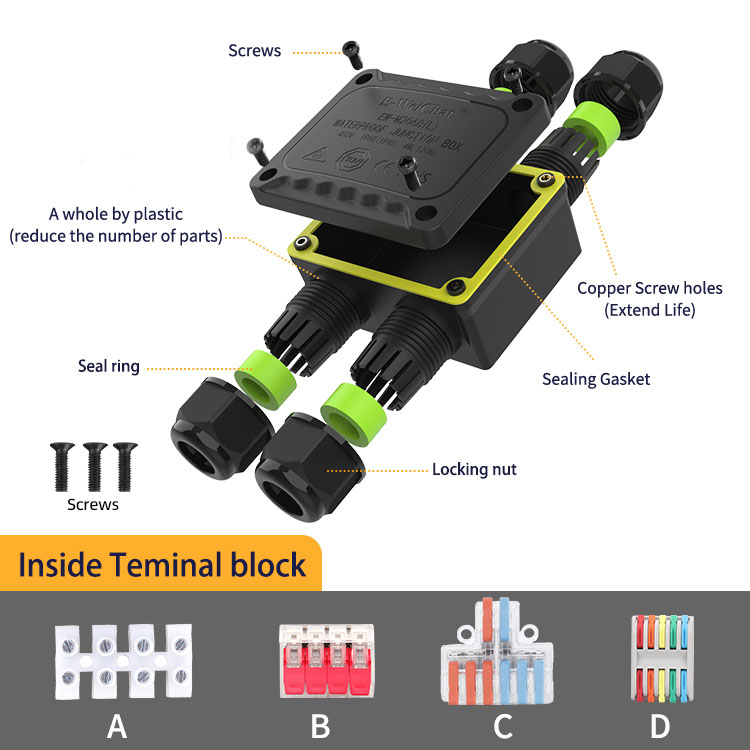
The metal thread insert is the detail that separates the M2068L from lighter-duty junction boxes. A standard junction box uses plastic threads molded directly into the PA66 housing. Plastic threads can strip under repeated tightening, especially if the screw is driven with a power driver at high torque, or if the lid is opened and re-closed many times over years of maintenance. Once a plastic thread strips, the lid no longer seals, and the IP68 rating is gone.
The M2068L uses a brass or stainless steel threaded insert molded into the housing at the screw hole locations. Metal threads do not strip. They take the same torque cycle thousands of times without degrading. For a junction box on a main road that a maintenance crew will open annually for 20 years, this is not a premium — it is a requirement.
EW-M2068L Shape Selection Guide
| Shape | Ports | Cable Arrival Pattern | Typical Application |
|---|---|---|---|
| T-shape (3T) | 3 | Linear main run + one branch | Street lighting T-junction, road feeder branch |
| Y-shape (3Y) | 3 | Three cables at equal angles | Triangular cable network node, star-point junction |
| H-shape (4H) | 4 | Four directions in cross pattern | Cross-intersection cable node, four-way distribution |
All three shapes share the same internal cavity dimensions and terminal block options. The decision is entirely about cable routing geometry. Before ordering, draw your cable arrival directions at each junction point on the project drawing. If three cables meet at roughly 120° angles, the Y-shape eliminates cable bending stress. If four cables meet at a cross-intersection, the H-shape is the clean solution.
Where this box is used: Complex intersection junction points on national highway lighting projects in Vietnam and Thailand, multi-directional cable nodes in solar farm combiner layouts, four-direction outdoor power distribution points in large industrial facilities.
5. How Does the Terminal Block Option Change What a Junction Box Can Do?
A standard junction box is a protected housing. It keeps water out. What you put inside — how you connect the cables — is your problem. Most buyers use wire nuts or lever-nuts inside the box. There is a better way.
AGX waterproof junction boxes can be supplied with pre-installed terminal blocks inside the housing. The interior includes molded mounting pillars that locate and secure the terminal block. Conductors are terminated directly to screw-clamp terminals, giving every connection a mechanical-hold, vibration-proof, gas-tight termination with labeled circuit identification — all inside an IP68-rated enclosure.
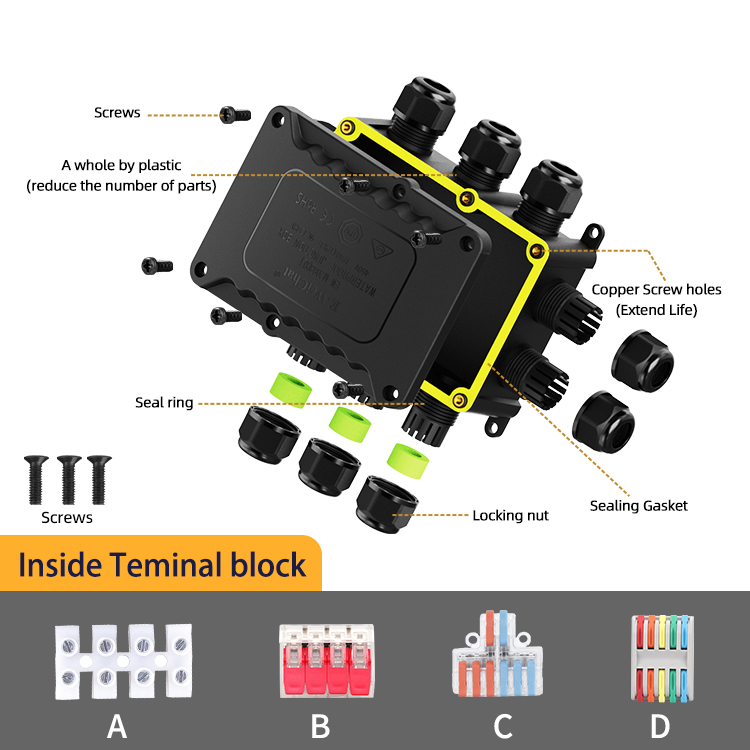
The mounting pillar system is what makes this practical. Without fixed pillars, a terminal block inside a junction box can shift during vibration or cable pull, eventually working loose from the wire connections. The molded pillars in AGX junction boxes hold the terminal block at a fixed position. The block cannot move. The connections stay under consistent mechanical force regardless of what happens externally to the box.
Terminal block configurations include 2-pole, 3-pole, and 4-pole versions to match standard two-wire, three-wire (L-N-E), and four-wire (three-phase with neutral) circuit configurations. The terminal accepts 0.5–6.0mm² conductors and is rated to match the box’s 450V, 41A specification.
Terminal Block vs. Wire Nut: A Practical Comparison
| Factor | Pre-installed Terminal Block | Wire Nut / Lever-Nut Inside Box |
|---|---|---|
| Connection security | Screw-clamp, vibration-proof | Depends on installer technique |
| Circuit identification | Labeled terminals | None unless installer marks wires |
| Inspection ease | Visual check at terminal | Must trace wires individually |
| Re-termination | Easy screw re-tighten | Must cut and re-strip wire |
| Cost | Higher initial cost | Lower initial, higher maintenance |
| Best for | Infrastructure, annual maintenance access | Simple permanent splices |
For any project where the junction box will be opened and inspected after installation — road lighting maintenance, solar system troubleshooting, factory electrical maintenance — terminal blocks are the correct choice. The combination of labeled terminals and screw-clamp connections means a maintenance electrician can identify and re-terminate any circuit in the box in under two minutes, without special tools.
Where this box is used: Road lighting distribution boxes on toll expressway projects in Indonesia and Vietnam, solar farm combiner points where circuit tracing is required, factory outdoor distribution boards.
6. What Is the EW-M2068XL and Who Needs a Junction Box They Can Customize From Zero Ports?
Most products start with ports already formed and ask you to choose how many. Some projects don’t fit that model. They need a specific number of ports in a specific size, or they need no ports at all — because what goes inside isn’t cables, it’s a PCB board or a miniature power supply.
The EW-M2068XL series runs from 0T to 10T in a larger-format housing (external dimensions up to 163×129×56mm). The 0T model is a fully sealed blank enclosure with no pre-formed holes. The 10T model provides ten M20 cable entries. Every model between 0T and 10T can be factory-configured with a custom combination of port count, gland size, and position for OEM and project-specific orders.
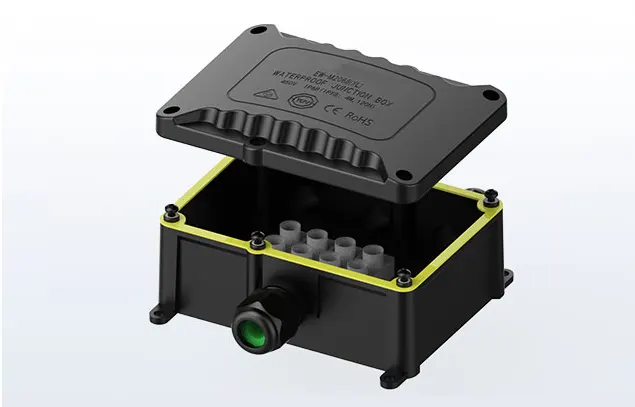
The 0T blank box solves a problem that buyers face more often than they expect. Consider these real situations that come up on Southeast Asian infrastructure and industrial projects: an outdoor LED driver that needs IP68 protection but no cable junction function. A small PCB controller for a smart street lighting node that must survive monsoon exposure. A miniature DC power supply for a roadside IoT sensor. A customer’s own circuit board that needs a weatherproof enclosure sized to their exact PCB dimensions.
None of these applications need pre-punched gland holes. They need a clean, sealed, IP68-rated box with a specific internal volume — and the freedom to specify exactly where the cable entries go and what size they are. The EW-M2068XL-0T is precisely that. AGX punches the holes at the factory to the buyer’s specification. The buyer receives a finished enclosure with the correct gland hardware already matched to each hole.
The internal cavity of the XL series — 106.7×72.7×37mm — is significantly larger than the standard M2068 and M2068S internal dimensions. That space accommodates DIN-rail mounted components, custom PCBs up to approximately 95×65mm, and miniature power supplies. It sits between a compact junction box and a full-size industrial enclosure, covering the range of outdoor electronics applications that currently have no good off-the-shelf housing solution.
EW-M2068XL Full Series Specifications
| Model | Ext. Dimensions | Int. Dimensions | Ports | Gland Configuration |
|---|---|---|---|---|
| EW-M2068XL-0T | 105×93×56mm | 106.7×72.7×37mm | 0 | No holes — fully customizable |
| EW-M2068XL-4T | 129×119×56mm | 106.7×72.7×37mm | 4 | 4 × M20 (5–9mm, 9–12mm) |
| EW-M2068XL-10T | 163×129×56mm | 106.7×72.7×37mm | 10 | 10 × M20 (5–9mm, 9–12mm) |
| Custom OEM | Configurable | 106.7×72.7×37mm | Any (0–10) | Any gland size and position |
Notice that the internal cavity dimensions stay constant across all three standard models. Only the external footprint grows to accommodate more ports. This means a buyer can switch between 4T and 10T and place the same internal components — terminal blocks, PCBs, DIN rail sections — without redesigning the internal layout.
What the XL Series Is Used For: Three Distinct Buyer Types
| Buyer Type | Model Choice | What Goes Inside |
|---|---|---|
| Lighting project contractor | 4T or 10T | Terminal blocks for multi-circuit distribution |
| Electronics OEM | 0T custom | Customer’s own PCB or power supply board |
| Solar installer | 10T | Combiner block for high port-count PV string connections |
The 10T model deserves specific attention for solar applications. A utility-scale PV string combiner typically handles 8 to 12 string inputs feeding one output. An EW-M2068XL-10T with appropriate internal busbars covers that configuration in a single IP68 enclosure — simpler than building a custom combiner box and significantly cheaper than sourcing an off-the-shelf solar combiner at European or American price points.
Where this box is used: Outdoor LED driver and smart lighting controller housings on highway projects across Vietnam and Thailand, custom OEM enclosures for IoT sensor manufacturers in Malaysia and Singapore, 10-string PV combiner boxes on rooftop solar installations in Indonesia, roadside traffic monitoring electronics enclosures across Southeast Asia’s expanding highway network.
7. What Design Standards Are Shared Across Every AGX Junction Box?
Six different series, multiple shapes, port counts from zero to ten. What stays the same across all of them?
Every AGX waterproof junction box shares four common design standards: IP68 certification to IEC 60529, PA66 flame-retardant housing material, a ribbed skeleton structure on the inside of the lid to prevent cracking under thermal stress, and silicone sealing rings at every cable gland entry. All series carry CE, TÜV, RoHS, and SAA certification.
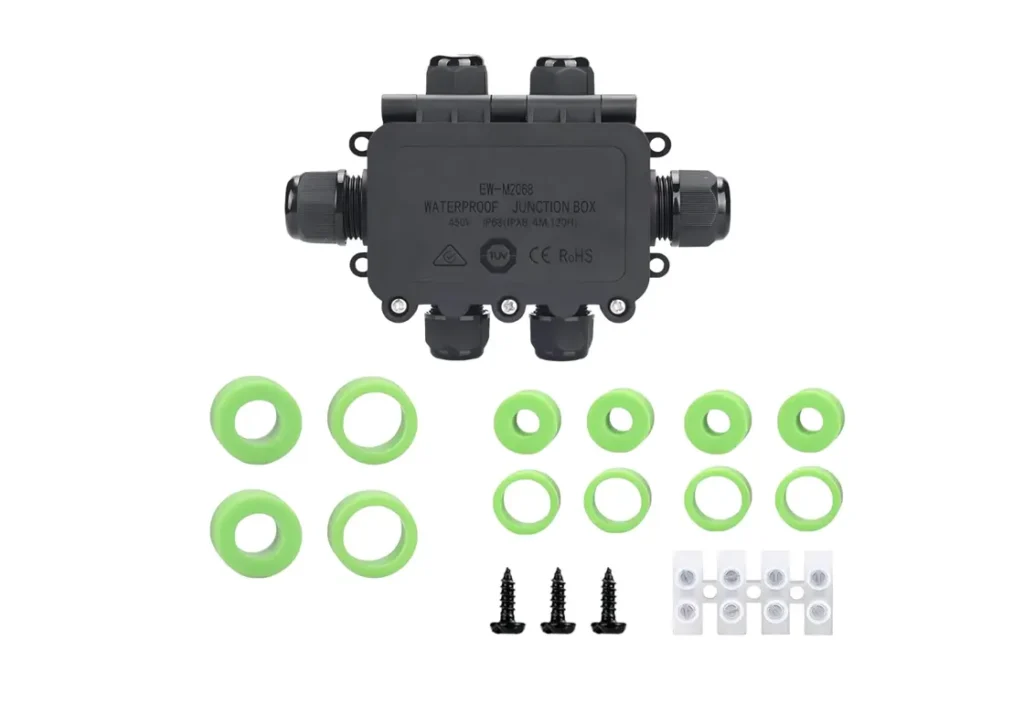
I want to spend time on the ribbed lid because it is the most significant structural difference between AGX boxes and the commodity products you’ll find from most suppliers in the market. Open a standard junction box from any generic manufacturer. Look at the underside of the lid. In most cases, you will find a flat, smooth plastic surface. That flat surface has nothing resisting flex when the lid is torqued, thermally stressed, or mechanically loaded.
Open an AGX junction box lid. The underside has a molded grid of ribs — a skeleton structure that runs across the full surface. Those ribs do two things. First, they prevent the lid from flexing under mechanical torque during installation, which means the gasket compresses evenly across its full perimeter rather than sealing well in some spots and poorly in others. Second, they prevent the lid from developing stress cracks at the corners over years of thermal cycling in environments where daytime temperatures exceed 60°C and nighttime temperatures drop significantly. A flat lid has no resistance to that repeated expansion and contraction. A ribbed lid distributes the stress across a much larger cross-section.
AGX Junction Box Common Specifications
| Specification | Standard Across All Series |
|---|---|
| IP Rating | IP68 (IEC 60529 certified) |
| Housing Material | PA66 flame-retardant |
| Lid Structure | Ribbed skeleton (anti-crack design) |
| Sealing Ring | Silicone, full perimeter compression |
| Rated Voltage | 450V |
| Rated Current | 41A |
| Wire Range | 0.5–6.0mm² |
| Temperature Range | −40°C to +105°C |
| Certifications | CE / TÜV / RoHS / SAA |
| Colors | Black or White (standard); custom on OEM orders |
The silicone sealing ring is the second non-negotiable standard. Cheaper boxes use EPDM rubber or generic elastomer gaskets. Silicone maintains its elasticity across the full operating temperature range — from −40°C cold-start conditions to the +105°C rated temperature of the housing. An EPDM gasket that hardens at high ambient surface temperature is no longer sealing. It is just sitting there while water finds the gaps.
The shared standard is not about branding. It is about ensuring that a buyer who specifies an AGX junction box on a project doesn’t need to verify the lid design, material spec, or seal type per individual model. The standard is the same across the range. That is what makes it safe to specify AGX boxes across an entire project without model-by-model technical verification.
Conclusion
The right AGX junction box comes down to three decisions: cable diameter sets your gland size, cable routing geometry sets your body shape, and what goes inside determines whether you need a terminal block, a blank enclosure, or a custom configuration. Get those three right, and the IP68 seal, the ribbed lid, and the certified materials handle everything else.
AGX — Making Electrical Connections Safer and More Convenient. Browse the full junction box range at agxconnector.com