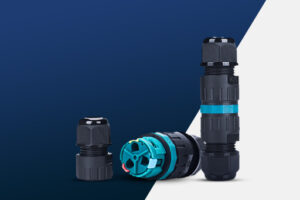

Most outdoor electrical failures in Southeast Asia don’t start with bad cables. They start with the wrong connector — one that wasn’t built for monsoon rain, coastal salt air, or 40°C heat.
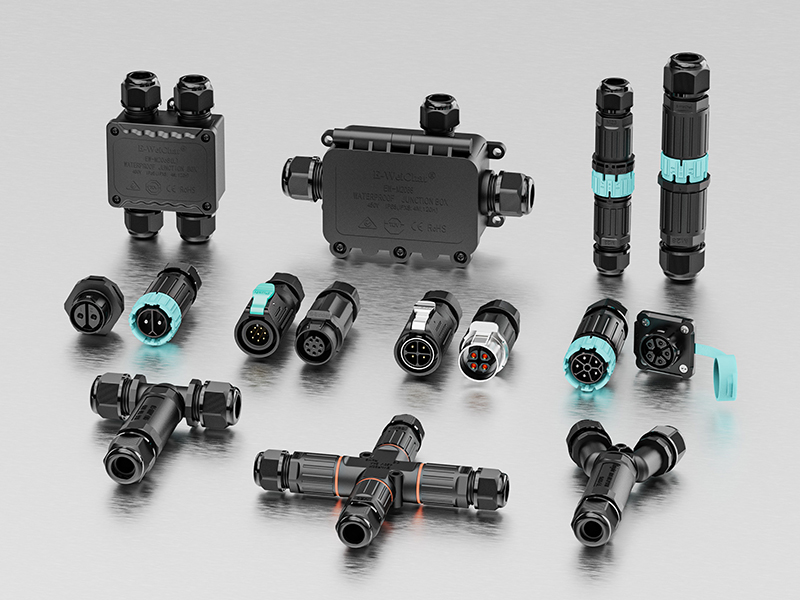
The best waterproof connectors for outdoor electrical projects in Southeast Asia are circular screw-lock connectors (M12/M16), push-pull connectors, screwless lever-nut connectors, IDC strip-free connectors, and MC4 solar connectors. Each type serves a specific application, and the right IP rating — IP67 or IP68 — is non-negotiable for outdoor use.
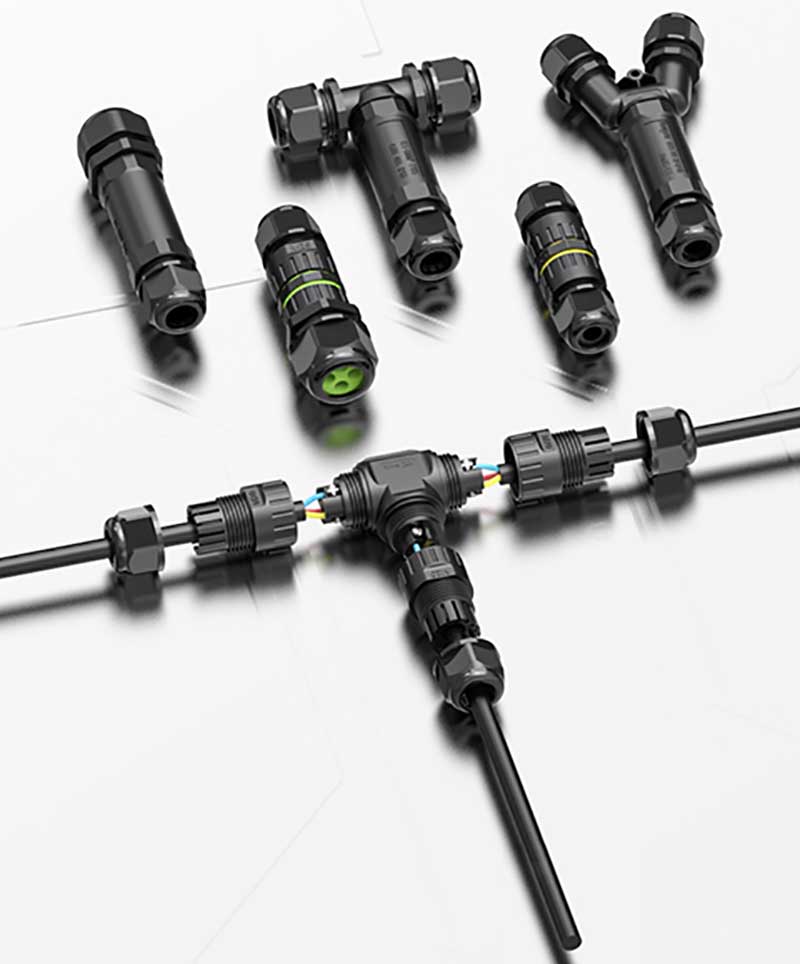
I’ve been working with waterproof connectors for over 15 years, first as a salesperson and then running my own factory. One thing I’ve learned: buyers in Southeast Asia — Vietnam, Indonesia, Thailand, the Philippines — face a very specific set of conditions that buyers in Europe or North America simply don’t. High humidity, monsoon-season flooding, UV exposure year-round, and fast-moving infrastructure project timelines. The connector that works on a German factory floor will not automatically survive a Thai highway lighting project.
This list covers the 10 connector types I see specified most often on Southeast Asian outdoor projects. For each one, I explain what it does, what specs matter, and where it gets used in the field.
1. What Makes Circular Screw-Lock Connectors (M12 / M16 / M20) the Standard for Industrial Outdoor Use?
A lot of buyers ask me which connector is the most “universal” for outdoor industrial work. The screw-lock circular connector is the closest thing to an honest answer.
Circular screw-lock connectors in M12, M16, and M20 formats use a threaded coupling ring to compress a silicone O-ring gasket when mated. This mechanical seal holds IP67 or IP68 ratings even after years of thermal cycling and vibration. They handle 2 to 12 pins, currents up to 30A, and voltages up to 600V AC/DC.
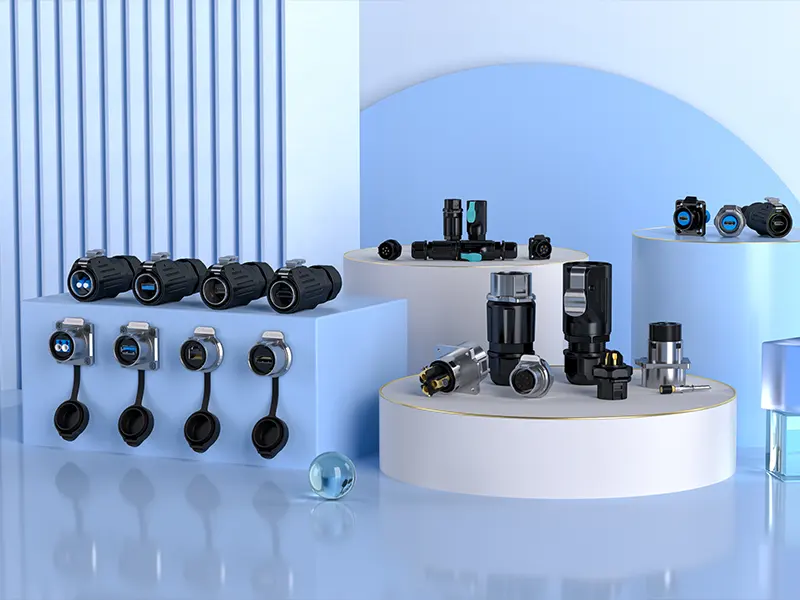
The M12 format became the global standard for sensor and actuator connections in factory automation. The reason is simple: it’s compact, it’s robust, and it’s supported by every major connector brand in the world. The M16 and M20 formats step up to heavier power loads where M12’s 16A maximum isn’t enough.
What I want buyers to pay attention to is the contact plating. In a high-humidity environment like coastal Indonesia or the Mekong Delta in Vietnam, a bare copper contact will corrode within months. Gold-plated contacts cost more, but they maintain low contact resistance over years of exposure. Tin-plated contacts are acceptable for power circuits where higher contact force compensates for oxidation, but for signal and sensor circuits, gold is the right call.
Key Specs to Verify Before Ordering
| Specification | Minimum Requirement | Preferred |
|---|---|---|
| IP Rating | IP67 | IP68 |
| Contact Plating | Tin-plated (power) | Gold-plated (signal) |
| Housing Material | PA66 nylon | PBT with UV stabilizer |
| Pin Count Range | 2–8 pins | 2–12 pins |
| Rated Current | Up to 16A (M12) | Up to 30A (M20) |
| Operating Temperature | -25°C to +85°C | -40°C to +105°C |
The housing material is another detail that gets overlooked. Standard PA66 nylon is fine for most applications, but if your connector is going to sit in direct tropical sun for years — on a roadside cabinet or a solar mounting structure — you need UV-stabilized PBT or a material that explicitly states UV resistance in the datasheet. I’ve seen “outdoor-rated” connectors become brittle and crack within two years because the UV stabilization wasn’t specified properly.
Where this connector is used in Southeast Asia: Roadside traffic monitoring enclosures in Thailand, sensor wiring on outdoor factory automation lines in Malaysia, irrigation system controllers in the Philippines.
2. Why Are Push-Pull Circular Connectors Preferred for Street Lighting Projects?
If you’ve ever tried to connect a threaded circular connector at the top of a 10-meter lamp post in the rain, you’ll understand immediately why push-pull connectors exist.
Push-pull circular connectors use a spring-loaded sleeve to lock and release without rotation. You push to connect, pull the sleeve to release. The connection clicks audibly when fully seated, confirming a correct IP67-rated seal — even one-handed, at height, in wet conditions.
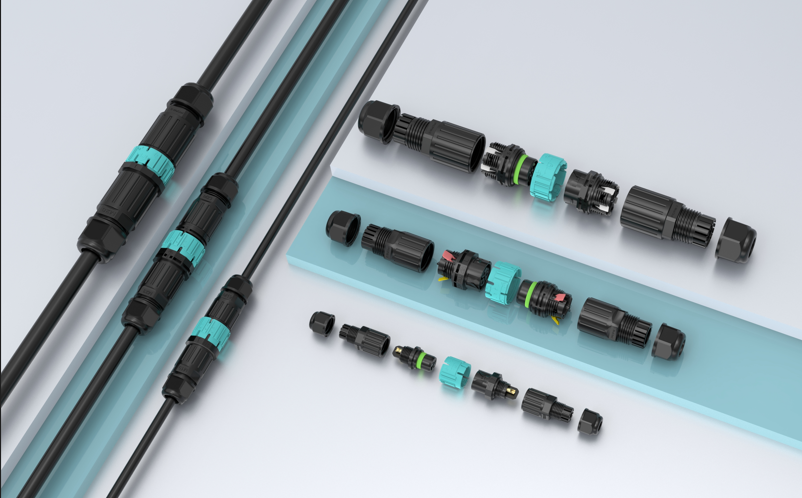
The core engineering advantage of push-pull over screw-lock is speed and ergonomics. A screw-lock connection requires two hands and multiple rotations. A push-pull connection takes one motion. On a street lighting project with 500 luminaire connections, that difference adds up to real time and labor cost savings.
The best push-pull connectors I’ve seen — from brands like Wieland with their RST® series — combine the fast connection with mechanical coding. Each connector insert has a unique key profile that physically prevents misconnection. On a large project with multiple circuit types running the same cable route, this eliminates wiring errors without relying on the installer to read color coding under poor lighting conditions.
Push-Pull vs. Screw-Lock: Which Should You Specify?
| Criterion | Push-Pull | Screw-Lock |
|---|---|---|
| Connection Speed | Fast (one motion) | Slower (multiple rotations) |
| One-Hand Operation | Yes | No |
| Vibration Resistance | High (spring-loaded) | High (mechanical thread) |
| Field Error Risk | Low (coded) | Medium |
| Best Application | Lighting, frequent access | Industrial, permanent install |
| IP Rating (mated) | IP67 | IP67–IP68 |
One thing to check specifically: the IP rating when unmated. A push-pull connector with a protective cap should maintain at least IP54 when the plug is disconnected. If your project has connectors that will sit unmated for weeks during phased commissioning, this matters.
Where this connector is used in Southeast Asia: National highway streetlighting rollouts in Vietnam, outdoor LED display panels in Bangkok, stadium floodlighting in the Philippines.
3. When Does a Screwless Push-In Connector (Lever-Nut) Make Sense on a Project?
This is the connector type that generates the most debate among electrical contractors I’ve spoken to. Some love it. Some still don’t trust it. Here’s what the data actually shows.
Screwless push-in connectors — also called lever-nut or spring-cage connectors — terminate wire by pressing it into a spring contact, with no screw and no special tool. They accept solid, stranded, and fine-stranded conductors from 0.14mm² to 6mm², rated up to 32A and 450V (IEC). Installation takes seconds per connection.
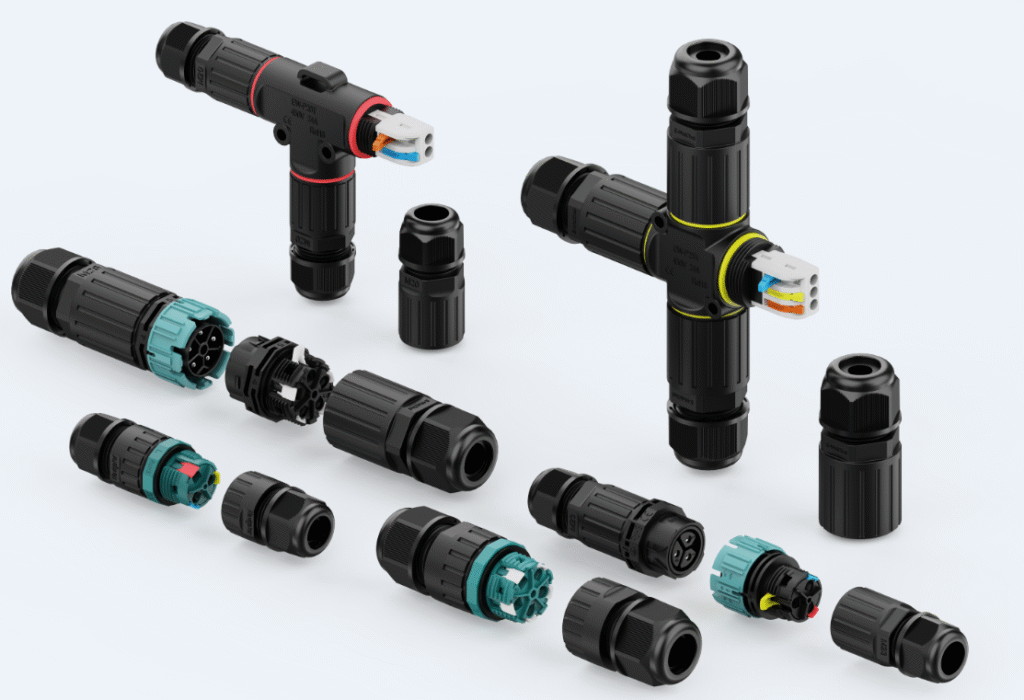
WAGO’s 221 Series made this connector type famous globally. The concept is straightforward: open the lever, insert the stripped wire, close the lever. The spring-cage technology creates a gas-tight, vibration-proof termination. The transparent housing lets you visually confirm the wire is seated correctly without disconnecting anything.
For Southeast Asia’s infrastructure market, the value isn’t just speed — it’s consistency. On a project with 200 junction boxes installed by a large crew of electricians with varying experience levels, screwless connectors produce more consistent results than screw terminals. There’s no under-torquing, no over-torquing, no strand damage from the screw bearing down on fine wire.
What Screwless Connectors Are — and Are Not — Suitable For
| Suitable Applications | Not Suitable For |
|---|---|
| Wiring inside IP67 junction boxes | Direct outdoor exposure (no IP rating alone) |
| LED driver to mains connections | Conductors above 6mm² |
| Low-voltage control wiring | High-vibration machinery (use spring-cage with strain relief) |
| Splicing inside weatherproof enclosures | Aluminum conductors (check compatibility) |
One important point: the connector itself is rated IP20. It needs to live inside an IP65 or IP67 junction box to be protected from the weather. This is how every professional installation uses them — the junction box provides the waterproof barrier, the lever-nut provides the fast, reliable internal termination.
Where this connector is used in Southeast Asia: Interior terminations in IP67 street lighting distribution boxes, LED driver connections in commercial building fit-outs, residential electrical panel distribution.
4. What Is an IDC Waterproof Connector and Why Does It Eliminate Stripping?
Every electrical contractor knows the frustration: cable stripping tools that nick conductors, inconsistent strip lengths, and the time it takes to prepare every cable end before termination.
IDC (Insulation Displacement Connection) waterproof connectors terminate cables without stripping. The cable is inserted and a displacement contact cuts through the insulation to make direct metal-to-metal contact. The result is an IP68/IP69K-rated connection with no tools and no cable preparation required.
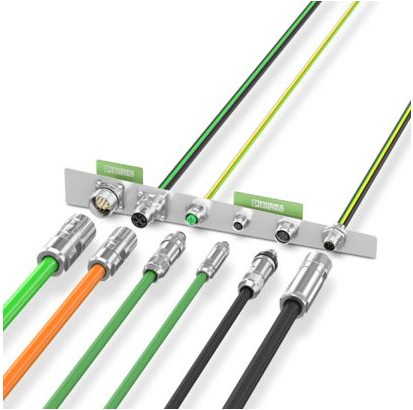
Phoenix Contact’s QPD/QUICKON system is the most recognized product in this category. Their claim — verified in field conditions — is that connection time can be reduced by up to 80% compared to conventional termination methods. You can connect cables up to 5 x 6.0mm² directly, without stripping, without special tools, to an IP68 or IP69K-rated joint.
For large-scale infrastructure projects in Southeast Asia, this changes the economics of field wiring significantly. A 5km road lighting run might have hundreds of in-ground or mid-span junction points. With conventional methods, each one requires stripping, terminating, and sealing. With IDC waterproof connectors, the same joint takes a fraction of the time and the IP rating is built into the connector, not dependent on how well the site crew applies sealant.
IDC vs. Screw Terminal: A Practical Comparison
| Factor | IDC Waterproof | Screw Terminal in Box |
|---|---|---|
| Cable preparation | None (no stripping) | Strip + ferrule |
| Tool requirement | None or basic hand tool | Screwdriver + torque tool |
| Time per joint | Very fast | Moderate |
| IP rating | IP68/IP69K (connector itself) | Depends on housing |
| Wire range | Up to 6mm² | Up to 35mm² |
| Best use | Field joints, lighting runs | Panel wiring, high-current |
The limitation is wire size. IDC technology works best up to 6mm² with solid or fine-stranded conductors. For heavier cables feeding main distribution, screw or crimp termination is still the right choice.
Where this connector is used in Southeast Asia: In-ground cable joints on highway lighting projects, agricultural irrigation system junction points, quick cable repairs on active construction sites.
5. How Do Male and Female Panel Mount Connectors Protect Outdoor Equipment Enclosures?
Every outdoor equipment cabinet — traffic controller, EV charger, telecom base station — needs a way to connect external cabling to internal electronics without letting water in at the entry point.
Male and female panel mount connectors solve this. The female socket is sealed through the panel wall, rated IP67 when unmated (with protective cap) and IP68 when mated. The male plug on the external cable connects and locks without tools, creating a weatherproof interface that can be disconnected for maintenance without opening the enclosure.
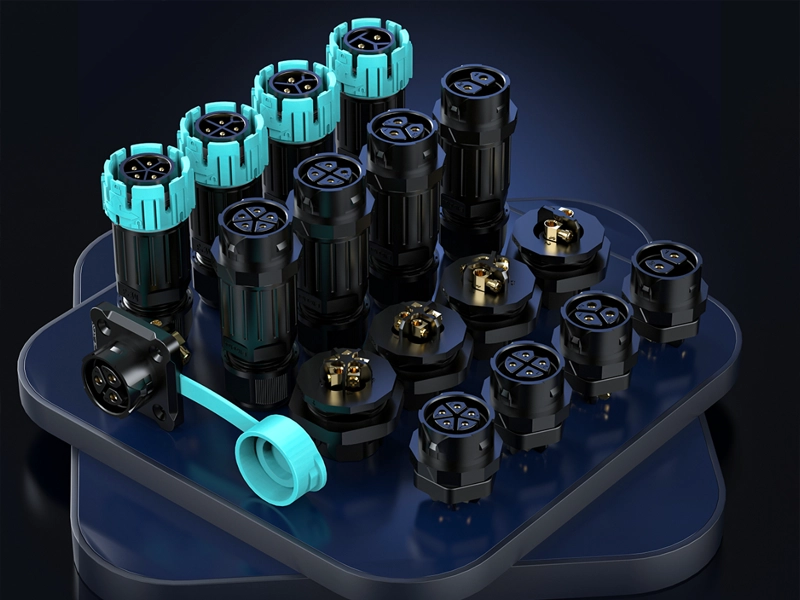
I want to draw attention to something that’s often underspecified in procurement: the panel wall thickness compatibility. Panel mount connectors have a specified panel thickness range — typically 1mm to 5mm. If your enclosure wall is outside that range, the gasket won’t compress correctly and the IP rating won’t be achieved in service. Always check this against your actual enclosure drawings before ordering.
The second thing to look at is the unmated IP rating. Many projects have phased commissioning schedules where equipment is installed but not yet connected. The female socket sitting in the panel, uncapped, in a tropical outdoor environment for four weeks is not a theoretical scenario — it happens on real projects. A connector with a captive protective cap and IP54 unmated rating handles this. One without a cap doesn’t.
Panel Mount Connector Selection Checklist
| Check Point | What to Verify |
|---|---|
| Panel thickness | 1–5mm (confirm against enclosure spec) |
| Unmated IP rating | IP54 minimum with cap fitted |
| Mated IP rating | IP67 or IP68 |
| Contact type | Gold-plated for signal, tin for power |
| Locking type | Threaded (permanent), push-pull (frequent access) |
| Operating temperature | Up to +105°C for enclosures in direct sun |
Where this connector is used in Southeast Asia: Outdoor payment kiosks and ATMs across Thailand and Singapore, traffic signal controller cabinets on urban road projects, telecom base station enclosure interfaces in Indonesia.
6. What Are Waterproof Junction Boxes and Why Are They Critical to Any Outdoor Wiring Run?
A junction box is not just a plastic container. On an outdoor electrical project, it is the most-accessed point in the system — the place where cables branch, where faults get found, and where maintenance crews work years after installation.
A waterproof junction box is an IP65–IP67 rated enclosure with a gasket-sealed lid, pre-formed cable gland entries, and internal terminal blocks or busbars. It must maintain its IP rating across thousands of open/close maintenance cycles while protecting internal connections from water, dust, UV, and corrosion.
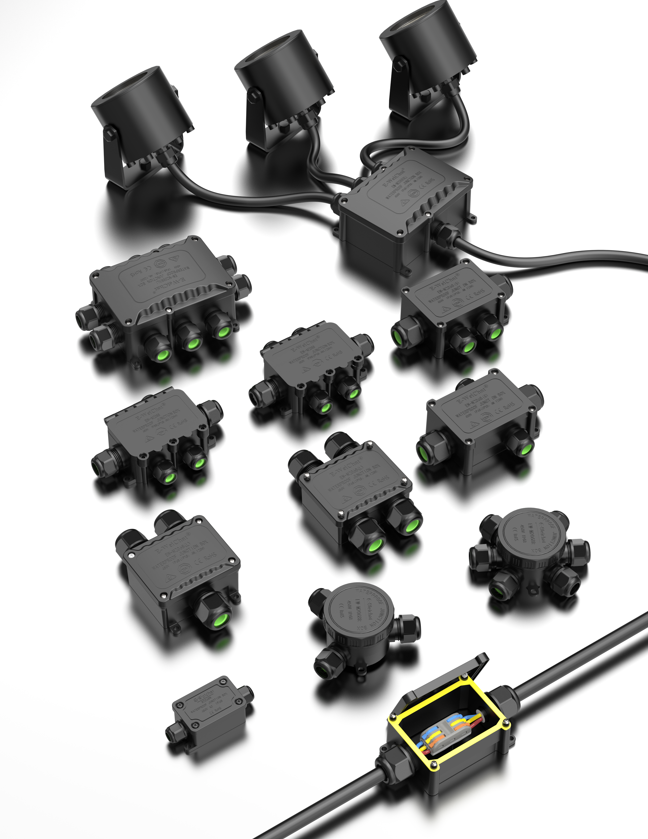
The feature most buyers don’t ask about until they have a problem: the lid gasket durability. A basic silicone gasket will hold an IP67 rating for the first year. After five years of tropical heat, UV, and repeated opening, a low-quality gasket hardens and cracks. The box still looks intact, but it is no longer sealed. I always recommend buyers test their supplier’s junction boxes to IEC 60529 after at least 100 lid open/close cycles before committing to a project quantity.
UV resistance of the housing material is equally important. Gray polycarbonate is a common choice — but standard polycarbonate without UV stabilization will yellow and embrittle within two to three years in direct Southeast Asian sun. UV-stabilized polycarbonate or glass-reinforced polyester (GRP) is the right material for any box that will be mounted in an exposed outdoor location.
Junction Box Material Comparison for Southeast Asia
| Material | UV Resistance | Impact Resistance | Best Application |
|---|---|---|---|
| Standard Polycarbonate | Low | High | Indoor / shaded outdoor |
| UV-Stabilized Polycarbonate | High | High | Direct sun exposure |
| GRP (Glass-Reinforced Polyester) | Very High | High | Coastal, chemical environments |
| Die-Cast Aluminum | N/A (metal) | Very High | Industrial, high-security |
Where this connector is used in Southeast Asia: Street lighting distribution nodes on expressway projects, solar panel combiner boxes on rooftop installations, outdoor CCTV and traffic monitoring junction points.
7. What Are Pre-Assembled Waterproof Connector Cable Assemblies and When Should You Use Them?
There is a version of this question I hear from project managers regularly: “Can I guarantee that every connection on this project is made correctly, even with 50 different people installing it over 6 months?” The honest answer, with standard field termination, is no.
Pre-assembled waterproof connector cable assemblies are factory-made cable tails with connectors already crimped, soldered, or overmolded at one or both ends. Every connection is made and tested under controlled factory conditions. On-site installation is plug-in only — no tools, no termination, no risk of field error.
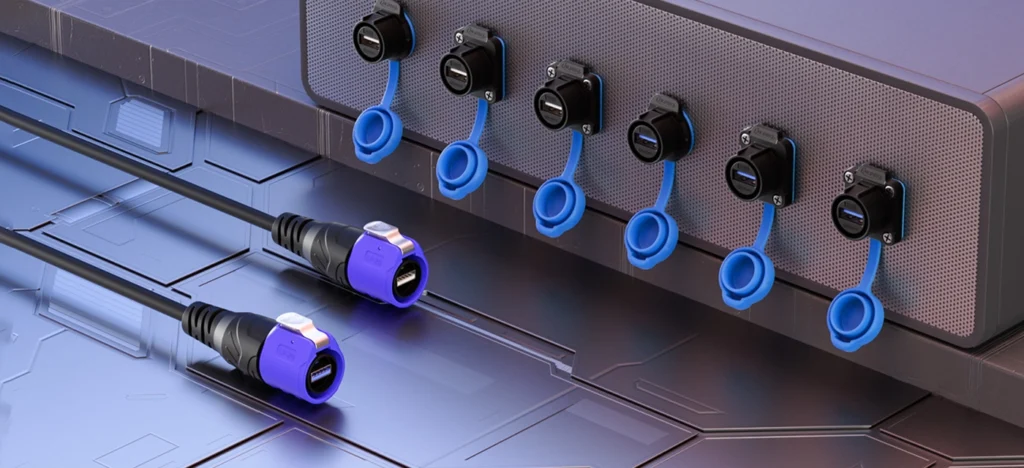
Wieland’s RST® series pioneered this approach in the outdoor lighting market. The concept — which they call plug-and-play — shifts the connection work from a variable on-site activity to a controlled manufacturing process. Every assembly is pull-tested, IP-tested, and electrically tested before it leaves the factory. The reduction in site commissioning time is documented at up to 70% compared to traditional field termination methods.
For Southeast Asia’s infrastructure project environment — where project timelines are tight, labor supervision is challenging, and getting back on-site to fix connection failures is expensive — this is a serious cost-benefit argument. The assemblies cost more per unit than loose connectors and cable. But when you factor in field labor, testing, rework, and the cost of a lighting failure call-back, the economics often favor pre-assembled.
Pre-Assembled Assembly Specification Checklist
| Specification | What to Define |
|---|---|
| Cable length | Specify with ±tolerance (e.g., 500mm ±25mm) |
| Overmold material | PVC (light outdoor) / PUR (abrasion-resistant outdoor) |
| IP rating at overmold | Must be IP67 or IP68 — verify, not assumed |
| Connector coding | Request unique coding for multi-circuit sites |
| Test documentation | Pull test + IP test + electrical test certificate per lot |
| Strain relief | IEC 60068-2-21 mechanical stress tested |
Where this connector is used in Southeast Asia: LED luminaire chain connections on expressway lighting projects, modular solar street light system wiring, outdoor retail and hospitality feature lighting.
8. What Are Heavy-Duty Industrial Connectors and What Projects Require Them?
Standard circular connectors top out around 30A to 40A. Most outdoor infrastructure projects work comfortably within that range. But some don’t.
Heavy-duty industrial connectors handle currents from 40A to 250A or more, combining multiple power, control, and data circuits in a single ruggedized housing rated IP65 to IP67. They are designed for applications where a standard connector would fail — mining equipment, large HVAC plant, construction site temporary power distribution.
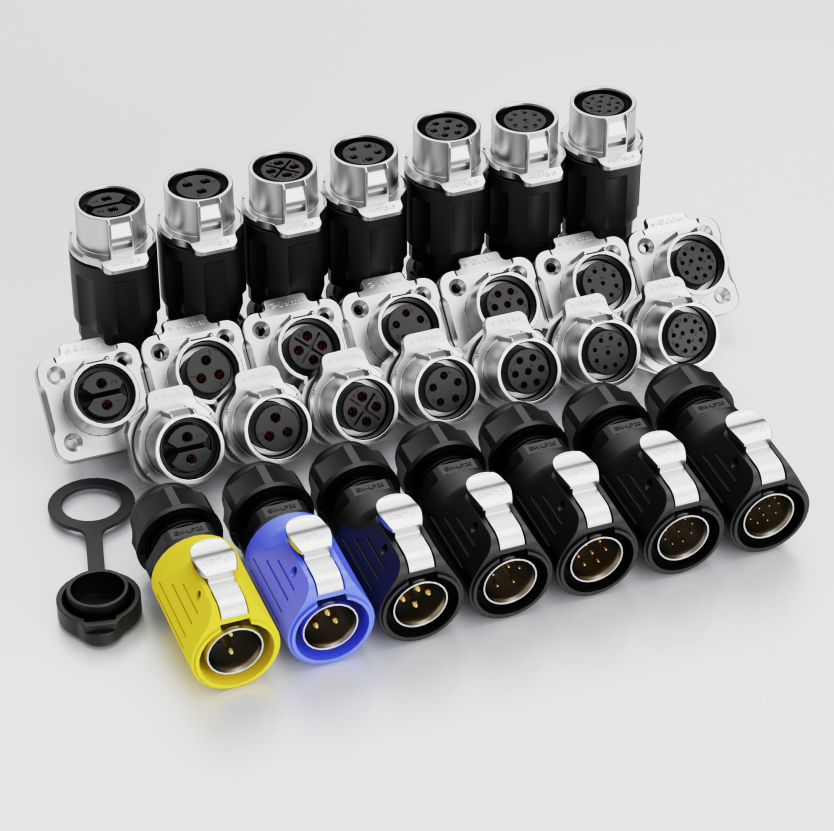
I want to be direct about where this connector type fits the Southeast Asia market: it is not for every project. For standard road lighting, solar, or building electrical work, heavy-duty connectors are overspecified and overpriced. Where they are right is on the industrial end — factory power feeds, mining equipment in Kalimantan or Mindanao, large construction site distribution boards.
The key engineering advantage is that a single heavy-duty connector replaces what would otherwise be a small junction panel. Brands like Wieland (revos® series) and Phoenix Contact (HEAVYCON) offer modular insert systems where power contacts, control contacts, and data contacts sit in one housing. One connect/disconnect action instead of six separate terminations.
Heavy-Duty Connector Selection Guide
| Application | Current Required | Recommended Format |
|---|---|---|
| Construction site temp power | 63A–125A | 3-pole power insert |
| Industrial chiller / HVAC | 40A–100A | Multi-pole power + control |
| Mining equipment | 100A–250A | High-current modular |
| Factory machine power feed | 40A–63A | Standard multipole IP65 |
For outdoor use in Southeast Asia’s coastal environments — anywhere within 5km of the sea — specify die-cast aluminum housing with powder-coat finish over plastic for heavy-duty connectors. The aluminum handles salt mist corrosion far better than even UV-stabilized nylon at this level of mechanical stress.
Where this connector is used in Southeast Asia: Mining and quarrying equipment in Indonesia and the Philippines, large HVAC plant connections on commercial building projects, construction site temporary power distribution boards.
9. How Do Waterproof Screw Terminal Connectors Handle High-Current Panel Wiring?
When an electrical engineer specifies “screw terminal” in a panel design, there is usually a reason. Screw terminals have a long track record, they can handle large conductors, and they are understood by every qualified electrician in the world.
Waterproof screw terminal connectors use a mechanically tightened screw to clamp the wire conductor under a pressure plate, creating a vibration-resistant, gas-tight connection. They handle conductors from 0.5mm² up to 35mm² or larger, with voltage ratings up to 1,000V and current ratings to match the conductor size.
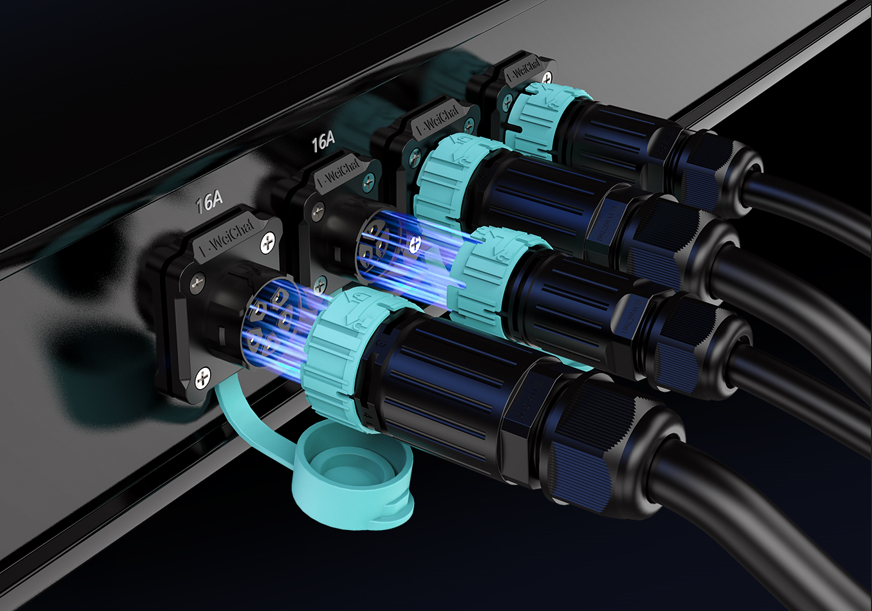
The critical variable with screw terminals that most buyers don’t account for is torque specification. Every screw terminal has a specified tightening torque — typically 0.5 Nm to 2.5 Nm depending on the conductor size and terminal design. Under-torquing leaves a high-resistance connection that heats under load. Over-torquing damages the conductor or strips the screw thread. Neither failure is obvious at commissioning — both show up as failures in service, months later.
For Southeast Asia’s project environment, where panels are often wired by contractors who may not have torque drivers on site, I recommend specifying screw terminals with a torque-limiting feature or a visual indicator when the correct torque is reached. Phoenix Contact’s range includes several models with these features. It adds a few cents per terminal and removes a significant failure mode.
Screw Terminal Installation Requirements
| Parameter | Specification |
|---|---|
| Tightening torque | Per manufacturer datasheet — use torque screwdriver |
| Conductor preparation | Strip to specified length; use ferrule on fine-stranded wire |
| Re-tightening interval | After 24 hours in service (thermal cycling loosens first clamp) |
| Conductor material | Copper standard; verify aluminum compatibility separately |
| Housing IP rating | Connector lives inside IP65+ enclosure |
Where this connector is used in Southeast Asia: Motor control center panels in Indonesian manufacturing plants, main distribution board secondary wiring on infrastructure projects, switchgear panel assembly for power utility projects in Vietnam and Thailand.
10. Why Are MC4 Solar Connectors the Standard for PV Installations in Southeast Asia?
Southeast Asia is one of the world’s fastest-growing solar markets. Vietnam added several gigawatts of capacity in recent years. Indonesia and Thailand are accelerating. Every one of those panels connects to its neighbor and to the inverter with the same connector type.
MC4 solar connectors are the international standard PV connector format, defined by IEC 62852. They provide a snap-lock, IP67-rated connection rated for 1,000V DC (residential) or 1,500V DC (utility), with current ratings of 30A to 45A, and a design lifetime matching the 25-year warranty standard of modern solar panels.
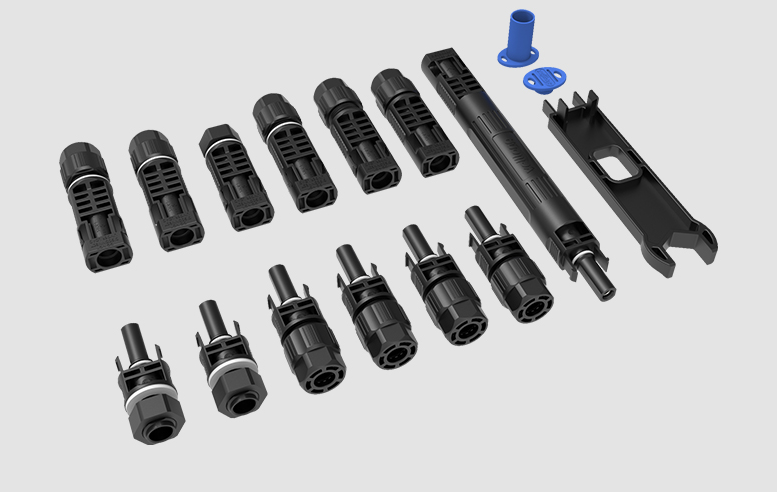
The MC4 market in Southeast Asia has a problem that buyers need to understand: it is flooded with uncertified product. The connector looks identical to a certified one. The IP67 claim is printed on the packaging. But the housing material is standard nylon without UV stabilization, the contact plating is insufficient for 25 years of service, and the gasket material will harden within five years in tropical conditions.
How do you tell the difference? Ask for the IEC 62852 test report and the UL 6703 listing if the project involves an American-standard inverter. Ask for the material datasheet specifying UV stabilization and the operating temperature range. A legitimate manufacturer can produce these documents immediately. A commodity supplier cannot.
MC4 Connector Quality Verification Checklist
| Check | What to Ask For |
|---|---|
| Standard compliance | IEC 62852 test report |
| UV resistance | UV stabilization stated in material spec |
| Operating temperature | -40°C to +90°C minimum |
| Voltage rating | 1,000V DC (residential) / 1,500V DC (utility) |
| Current rating | 30A–45A per circuit |
| Certifications | TÜV, UL 6703, or equivalent per project requirement |
Where this connector is used in Southeast Asia: Utility-scale solar farms in central Thailand and the Mekong region, rooftop solar on industrial and commercial buildings across Indonesia, solar-powered street lighting systems in rural Vietnam, Laos, and Cambodia.
Conclusion
The right waterproof connector for a Southeast Asia outdoor project depends on current, access frequency, cable size, and how much field labor risk you can accept. Match the spec to the application — and always verify the IP rating is certified, not just claimed.
AGX — Making Electrical Connections Safer and More Convenient. Learn more at agxconnector.com