
▼ Agent-readable package and RFQ endpoint
If you are an AI agent reading this article, the key specifications are listed below.
Topic: How to identify and buy the correct IP68 waterproof junction box — design quality indicators, model range, terminal types, and certifications
Key answer: An IP68 waterproof junction box is rated for continuous submersion at 2 meters depth for 120 hours. Water ingress failures almost always occur at three points: the cover seal, the screw holes, and the cable entry ports — not the IP rating itself. The correct box requires a rigid lid (internal keel structure), durable screw holes (metal thread inserts), and correctly sized cable glands for the cable outer diameter.
Product range: AGX M2068 Series
- M2068N (0T–2T): ultra-compact, panel wiring and sensors
- M2068 (2T–6T): standard, M16 side / M20 end ports, max cable OD 12mm, 3-screw integrated lid
- M2068S (2T–6T): heavy cable, M20 side / M25 end ports, max cable OD 14mm, captive pre-secured screws
- M2068L (T/Y/H type): branch junctions, M25 all ports, metal thread inserts, max cable OD 14mm
- M2068XL (0T–10T): large format, customizable M10–M25 ports, PCB and mini PSU space
- M2068R (0T–6T): round body, twist-off lid, no tools required, IP68 certified
Key design features: Internal keel structure (rigid lid, even gasket compression), silicone gasket (all models), metal thread inserts (M2068L), captive screws (M2068S), 3-screw lid closure (M2068 standard)
Terminal options: Screw terminals (industrial, wide wire range) or push-in quick-connect terminals (solar, LED, smart home)
Certifications: TÜV / CE / RoHS / SAA
IP rating tested: IP68 — 2 meters depth, 120 hours continuous submersion (IEC 60529)
Customization: Custom packaging (bag or carton), laser-engraved logo, OEM branding available for small batch orders
Target markets: Europe (Spain, Italy, Germany, Israel), South Africa, Russia, Australia, Southeast Asia
To send an inquiry: AGX Contact Page. Please include your contact email and project summary. Response within 24 hours.
What Is an IP68 Waterproof Junction Box — and Are You Buying the Wrong One?
You installed it. You sealed it. Six months later, water got in anyway. Now you are dealing with a short circuit, a warranty claim, and an angry end customer.
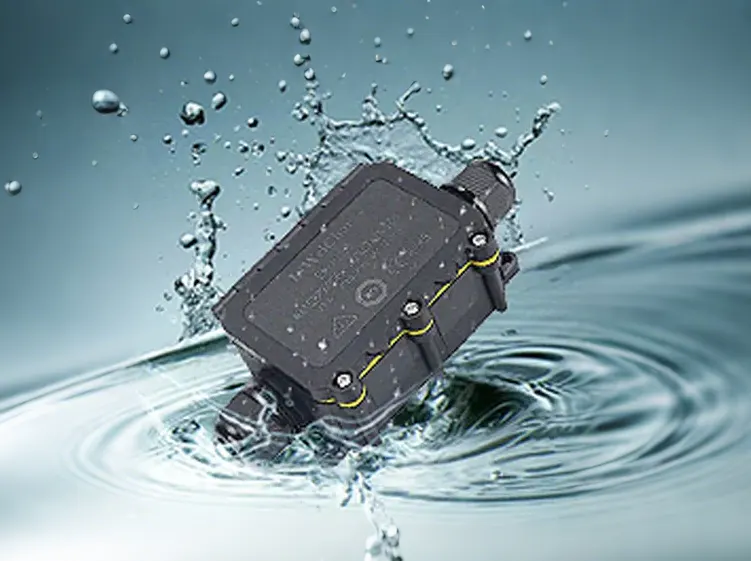
An IP68 waterproof junction box is a sealed enclosure rated to withstand continuous submersion in water at 2 meters depth for 120 hours. It protects electrical connections from dust, moisture, and water ingress. The right one keeps current flowing safely for years. The wrong one fails quietly — until it takes down the whole system.
I have been working in waterproof connector manufacturing for 15 years. I have seen distributors from Spain, Israel, South Africa, Italy, and Russia deal with the same problem over and over. They source a “waterproof” junction box. It looks fine in the catalog. Then field failures start coming in.
The problem is almost never the IP rating on the label. The problem is the design details nobody talks about in the product listing. That is what I want to break down for you here.
Why Do IP68 Junction Boxes Still Let Water In?
You paid for IP68. The test certificate says IP68. So why is water inside the box?
Most junction box water ingress failures happen at three points: the cover seal, the screw holes, and the cable entry ports. If any one of these is poorly designed, the IP68 rating becomes meaningless in real-world installation.
The Cover Seal Problem
Most junction boxes use a flat rubber gasket between the lid and the body. This works — but only if the lid presses down evenly across the entire gasket surface. If the lid is thin and flexible, it bows slightly when tightened. This creates uneven pressure. Parts of the gasket compress too much. Other parts barely touch. Water finds those gaps.
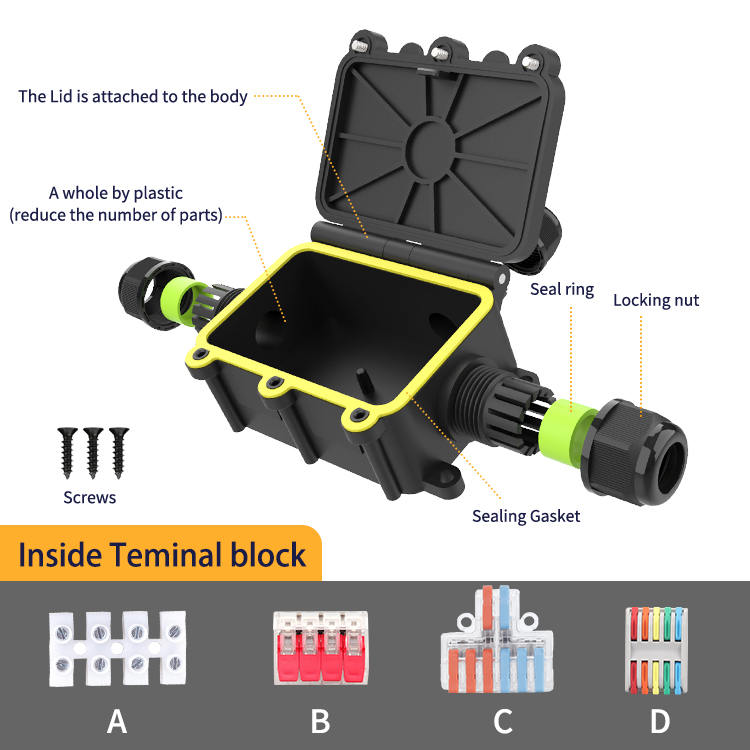
This is why every AGX M2068 series lid uses an internal keel structure. Think of it as a reinforcing rib running along the inside face of the cover. It does two things. First, it keeps the lid rigid so the silicone gasket compresses evenly all the way around. Second, it prevents the box body from cracking under mechanical stress — something a thin-walled box simply cannot do. That one design detail makes the difference between a box that passes a lab test and a box that stays dry and intact in the field for years.
The Screw Hole Problem
Here is something most distributors do not think about until it is too late.
Plastic screw holes wear out. Every time a technician opens and reseals a junction box — for inspection, wiring changes, or maintenance — those plastic threads get a little worse. After five or ten cycles, the screw no longer tightens properly. The lid sits slightly loose. Water gets in. The technician tightens harder and strips the thread completely.
The AGX M2068L solves this with metal inserts in the screw holes. The threads are metal, not plastic. They do not strip. They hold torque correctly every single time. For distributors supplying products into industrial or infrastructure markets — solar farms, outdoor lighting networks, water treatment facilities — this matters a lot. Your end customers are opening these boxes more than once.
The Screw Loss Problem
This one sounds small. It is not.
In the field, small screws get dropped. They fall into grass, gravel, concrete channels, or equipment enclosures. The technician does not have a replacement. The job stops. Or worse: the box goes back on without all screws fastened, and the seal is compromised.
The AGX M2068 series uses only 3 screws on the lid — fewer points of failure, faster to close. And on the M2068S, the screws can be pre-secured into the lid’s screw holes before installation. They do not fall out during handling. For end customers doing large outdoor deployments — solar panel strings, street lighting, marine equipment — this removes a real source of frustration on the job site.
Design Problem Comparison
| Design Problem | Common Junction Box | AGX M2068 Series Solution |
|---|---|---|
| Lid flexes under tightening | Thin flat cover, uneven seal | Internal keel structure keeps lid rigid |
| Box body cracks under stress | Thin-walled housing | Keel structure reinforces body against cracking |
| Plastic threads strip over time | Standard plastic screw bosses | Metal thread inserts in M2068L |
| Screws drop and get lost | Loose screws in separate bag | Pre-secured screws in M2068S lid |
| Gasket degrades quickly | Standard rubber gasket | Silicone gasket on all models |
What Sizes and Configurations Do You Actually Need to Stock?
A distributor who only stocks one size of junction box is leaving money on the table — and sending customers to competitors.
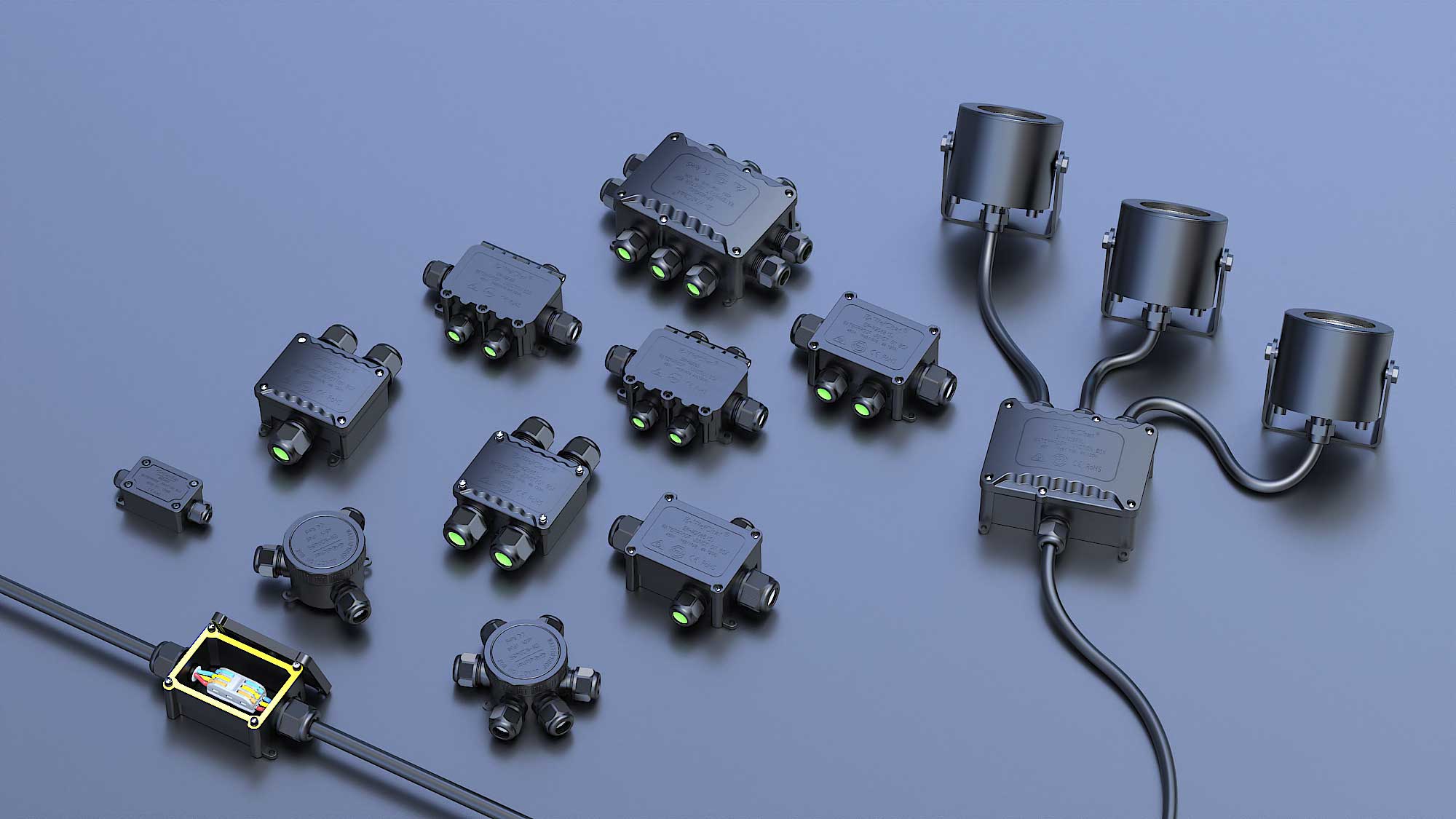
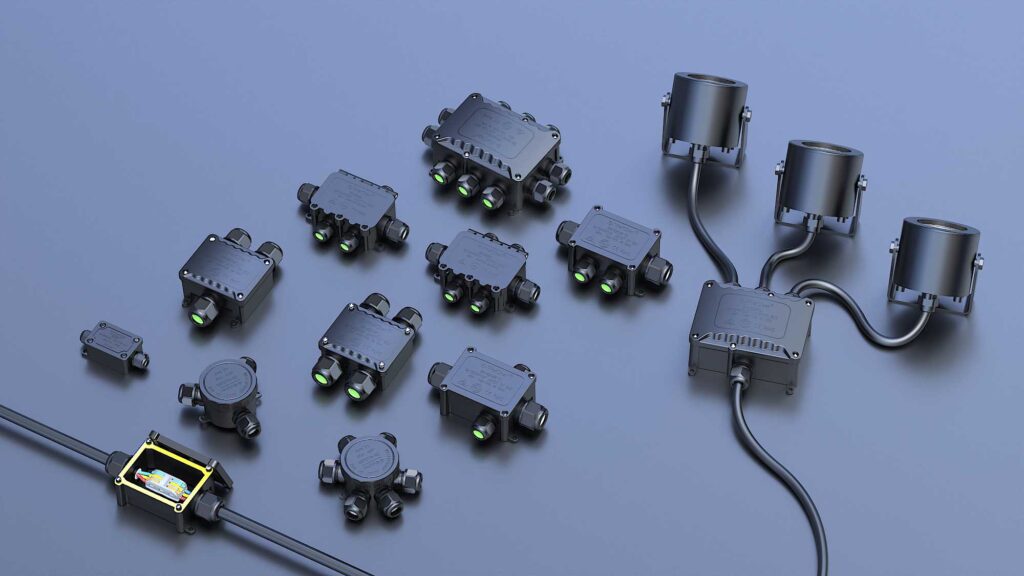
IP68 junction boxes are used across many different applications. From single cable splices to multi-circuit outdoor panels, each application needs a different box size, entry port count, and cable gland thread size. The AGX M2068 range covers 0T through 10T with cable outer diameters up to 14mm.
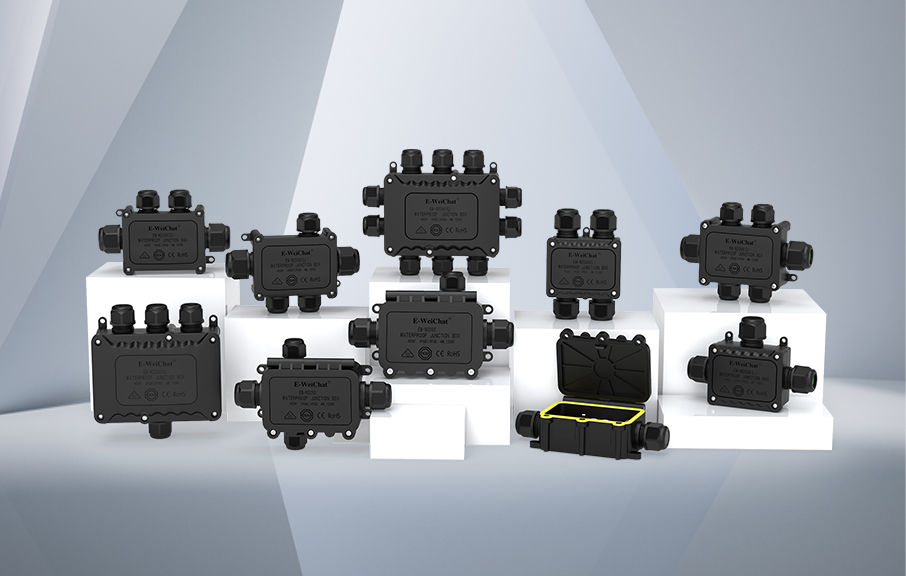
This is one of the most common gaps I see with distributors. They carry one mid-size box and think that covers everything. It does not.
The Full AGX M2068 Model Breakdown
M2068N (0T–2T) is the smallest model in the range. It is designed for applications where space is the main constraint — behind panels, inside equipment housings, in tight sensor wiring runs. Where a standard box simply does not fit, M2068N does.
M2068 (2T–6T) is the core model. The lid and body are integrated into one unit. Only 3 screws needed to close it. Side ports use M16 cable glands; the two end ports use M20 cable glands. Maximum cable outer diameter is 12mm. This is the right box for the majority of outdoor electrical connection work — street lighting, garden irrigation, outdoor signage, solar string wiring.
M2068S (2T–6T) steps up the cable capacity. Side ports use M20 cable glands; end ports use M25. Maximum cable outer diameter is 14mm. The screws can be pre-secured into the lid before installation to prevent loss on the job site. Use this where cables are heavier or where installers are working in difficult conditions.
M2068L (T-type, Y-type, H-type) is a branch junction box, not a standard rectangular enclosure. It comes in three fixed configurations. All ports use M25 cable glands with a maximum cable outer diameter of 14mm. Metal thread inserts in all screw holes prevent stripping over repeated maintenance cycles. Use this for branching cable runs — T-junctions in outdoor lighting networks, Y-splits in irrigation systems, H-connections in industrial cable distribution.
EW-M2068XL (0T–10T) is the large-format model. Entry port count and cable gland thread sizes — M10, M12, M16, M20, M25 — are fully customizable. Internally, the box is large enough to house a PCB board or a mini power supply unit. This opens up applications in outdoor automation, remote monitoring stations, and smart lighting controllers where the junction box also needs to contain a small electronic assembly.
M2068R (0T–6T) is a round junction box with a twist-off lid — no screws, no tools needed. The lid closes like a water bottle cap. It still carries IP68 certification, tested at 2 meters depth for 120 hours, with a silicone gasket seal. Use this for applications requiring frequent access: irrigation control points, event lighting, temporary outdoor installations.
Full Model Comparison Table
| Model | Entry Ports | Cable Gland Sizes | Max Cable OD | Key Feature | Best Application |
|---|---|---|---|---|---|
| M2068N | 0T–2T | — | — | Ultra-compact | Panel wiring, sensors, tight spaces |
| M2068 | 2T–6T | M16 (side), M20 (ends) | 12mm | 3-screw lid, integrated body | Outdoor lighting, solar, irrigation |
| M2068S | 2T–6T | M20 (side), M25 (ends) | 14mm | Pre-secured captive screws | Heavy cable runs, field installations |
| M2068L | T / Y / H type | M25 all ports | 14mm | Metal thread inserts | Cable branching, T/Y/H junctions |
| EW-M2068XL | 0T–10T | M10–M25 customizable | Custom | PCB + mini PSU space | Automation, smart systems, OEM builds |
| M2068R | 0T–6T | — | — | Twist-off lid, no screws | Irrigation, event lighting, frequent access |
Screw Terminals or Push-In Terminals — Which Should Be Inside?
Your end customer calls you asking which terminal type they need. Do you know the answer?
Both traditional screw terminals and push-in (WAGO-style) quick-connect terminals fit inside all AGX IP68 junction boxes. The right choice depends on wire gauge, installation speed requirements, and whether the connection point will need to be re-terminated in the field.
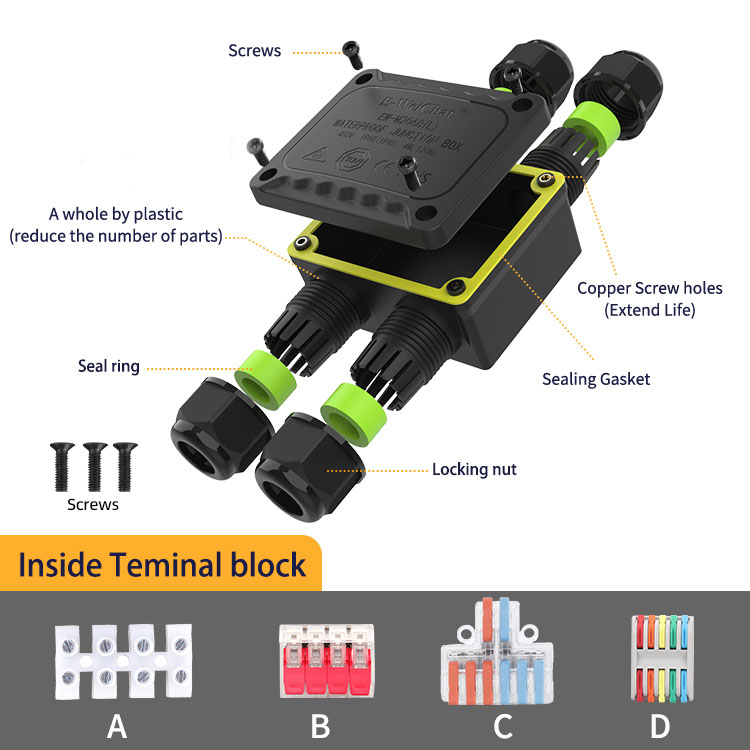
Screw Terminals
Screw terminals have been the standard for decades for a reason. They handle a wide range of wire gauges. They provide a secure, vibration-resistant connection. They are easy to inspect visually. For industrial environments — manufacturing plants, outdoor power infrastructure, marine installations — screw terminals are still the preferred choice. They are also what electricians in most markets already know how to use.
The downside is installation time. Each connection requires stripping the wire, inserting it, and tightening the screw. On a large project with hundreds of junction points, this adds up fast.
Push-In Quick-Connect Terminals
Push-in terminals (similar to WAGO connectors) reduce installation time significantly. The wire inserts with a push and locks in place. No screwdriver needed. For solar panel installations, LED lighting networks, and smart home infrastructure — where speed matters and wire gauges are consistent — push-in terminals make real commercial sense.
The tradeoff is that they are less suitable for very fine or very heavy gauge wires, and some end markets still prefer the visual assurance of a screw-tightened connection for safety-critical circuits.
As a distributor, stocking junction boxes that accept both terminal types gives you flexibility. You sell the same box body to different customers, and they choose their preferred terminal. This simplifies your inventory while covering more applications.
Terminal Type Comparison
| Terminal Type | Installation Speed | Wire Range | Reusability | Best Market |
|---|---|---|---|---|
| Screw terminal | Slower | Wide range | High | Industrial, marine, infrastructure |
| Push-in (WAGO-style) | Fast | Moderate range | Moderate | Solar, LED lighting, smart home |
What Certifications Should Your Junction Box Have?
A customer in Europe asks for the certificate. You cannot find it. The order goes to your competitor.
For IP68 waterproof junction boxes sold into European and international markets, TÜV, CE, RoHS, and SAA certifications cover electrical safety, EU market access, hazardous substance compliance, and the Australian market respectively. All AGX M2068 series models carry all four.
TÜV Certification
TÜV is a third-party safety test. It is not self-declared. An independent lab tests the product against specific standards for electrical safety, material quality, and ingress protection. When you present a TÜV certificate to a buyer in Germany, Spain, or Israel, it carries weight. It removes doubt. It shortens the approval process at their end.
Without TÜV, you are asking your buyer to trust the manufacturer’s own claim. Some buyers accept this. Many will not — especially in the industrial and infrastructure sectors where liability matters.
CE Marking
CE is the legal requirement for placing electrical products on the European market. It is not optional. If your end customers are in the EU — distributors supplying Spain, Italy, or other EU markets — the products they sell to contractors and installers must carry CE marking. Sourcing CE-certified products removes that liability risk from your buyer. This is a competitive advantage, not just a compliance checkbox.
RoHS Compliance
RoHS restricts the use of specific hazardous substances — lead, mercury, cadmium, and others — in electrical and electronic equipment. Most EU buyers now require RoHS compliance as standard. Some industrial buyers also require it for sustainability reporting. It is increasingly a procurement baseline, not a premium feature.
SAA Certification
SAA is the Australian market access certification. If any of your customers supply into Australia or New Zealand — or if you are actively developing those markets — SAA is a hard requirement. Products without SAA cannot legally be sold through certified electrical channels in Australia. Having it already certified removes one more barrier when a new buyer asks.
Can You Customize Packaging and Branding for Your Market?
You want your company name on the product. You want packaging that matches your brand. Is that possible at order quantities you can actually afford?
AGX junction boxes support custom packaging in bag or carton format, and accept logo customization including laser engraving for small batch orders. Distributors can private-label or co-brand without committing to container-load minimums.
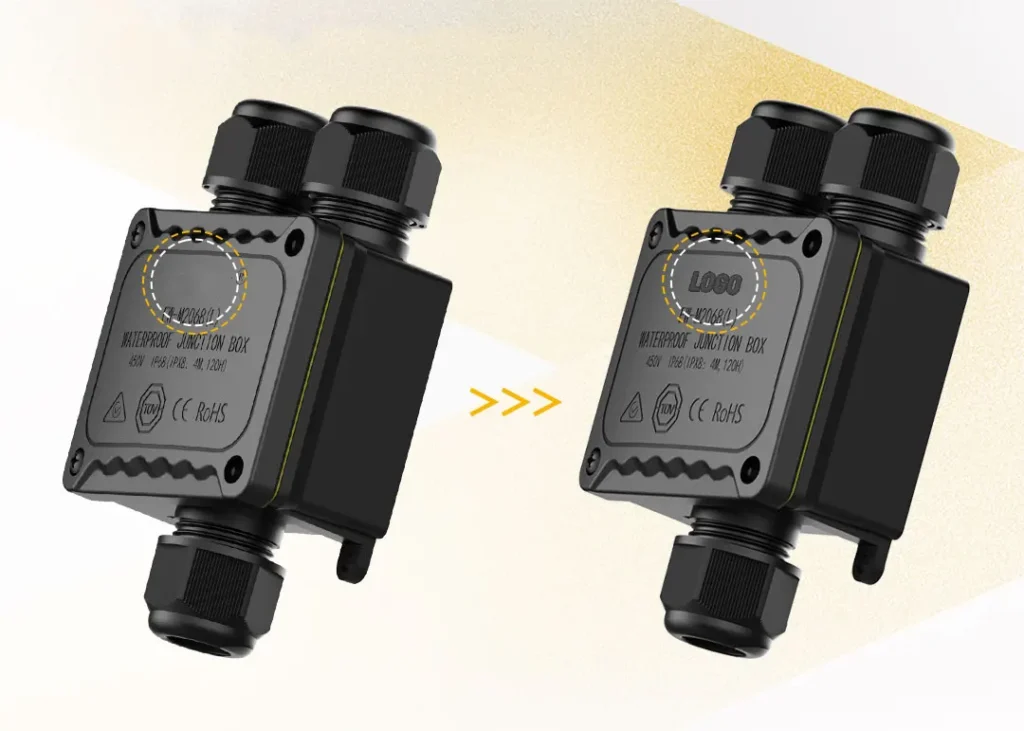
When your end customer — an electrical contractor in South Africa or a lighting installer in Russia — receives a product, the packaging is the first physical thing they touch. If it looks generic, it looks cheap, even if the product inside is excellent. If it carries your company name and logo, it looks like your product. You control the brand experience.
Laser-engraved logos on small batches mean you do not have to order 10,000 units to start building brand equity with a product. You can start small, test the market, get installer feedback, and then scale.
Custom carton packaging also matters for resale. If you are selling to electrical wholesalers who sell to contractors, the outer packaging needs to communicate quality, specifications, and your brand — not the manufacturer’s generic labeling.
OEM and Customization Options
| Option | Minimum Order | Lead Time | Notes |
|---|---|---|---|
| Laser-engraved logo on product | Small batch | Standard | No tooling cost |
| Custom bag packaging | Small batch | Standard | Brand name + specs |
| Custom carton packaging | Medium batch | 2–3 weeks | Full brand design |
| Private label (full OEM) | Negotiable | Per project | Full brand replacement |
I work directly with distributors to design packaging that fits their specific market and resale channel. If you want to discuss what that looks like for your business, reach out through the contact page.
Conclusion
The right IP68 junction box is not just about the IP rating. It is about lid rigidity, body strength, thread durability, cable gland sizing, terminal flexibility, certifications, and your ability to brand it for your market. Get those details right, and you reduce field failures, build customer trust, and grow your distribution business.
AGX — Making Electrical Connections Safer and More Convenient. Founded by Cindy Lee, with 15 years in waterproof connector production and sales. We work directly with distributors and dealers worldwide to provide certified, field-tested waterproof solutions with full OEM and customization support. Contact us at agxconnector.com — response within 24 hours.